
Search
Remove Ads
Advertisement
Search Results

Definition
Inari
Inari is the Shinto god of rice, the protector of food, and bringer of prosperity. He has over 40,000 shrines dedicated to him large and small across Japan, the oldest and most important of which is the Fushimi Inari Shrine near Kyoto...

Definition
Bimbisara
Bimbisara (c. 545/544 BCE - c. 493/492 BCE) was a king of the Magadha Kingdom who is credited with establishing imperial dominance in the Indian subcontinent. Son of a minor king called Bhattiya, he belonged to the Haryanka Dynasty...

Definition
Albrecht Dürer
Albrecht Dürer (1471-1528) was a German Renaissance artist who is considered one of the greatest painters and engravers in history. A native of Nuremberg, Dürer was famous in his own lifetime at home and abroad for his oil paintings...

Definition
East India Company
The English East India Company (EIC or EEIC), later to become the British East India Company, was founded in 1600 as a trading company. With a massive private army and the backing of the British government, the EIC looted the...

Definition
First Anglo-Sikh War
The First Anglo-Sikh War (1845-6) was a short and bloody conflict won by the British East India Company (EIC) against the Sikh Empire. The EIC was keen to expand into northern India, but the Sikh army was a well-trained, well-equipped...

Definition
Khmer Empire
The Khmer empire was a powerful state in South East Asia, formed by people of the same name, lasting from 802 CE to 1431 CE. At its peak, the empire covered much of what today is Cambodia, Thailand, Laos, and southern Vietnam. By...

Definition
Taj Mahal - Symbol of Love, Power, & Mughal Architecture
The Taj Mahal is a mausoleum complex in Agra, Uttar Pradesh, northern India. Commissioned by the Mughal Emperor Shah Jahan to inter and memorialise his wife Mumtaz Mahal, the building is the finest...
Definition
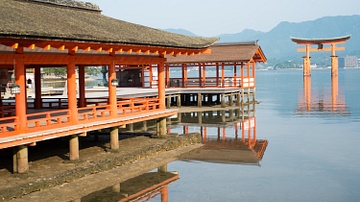
Itsukushima Shrine
Itsukushima Shrine is a Shinto shrine on the island of the same name, also known as Miyajima, located in Hatsukaichi, Hiroshima Prefecture, Japan. Traditionally founded in the 6th century CE, the present layout of buildings...

Definition
Pushyabhuti Dynasty
The Pushyabhuti Dynasty (c. 500 CE - 647 CE) rose after the downfall of the Gupta Empire (3rd century CE - 6th century CE) in the 6th century CE in northern India. Also known as the Vardhana or Pushpabhuti Dynasty, the core...

Definition
Ancient Afghanistan
The ancient history of Afghanistan, a landlocked country in Central Asia, is full of fascinating cultures, from early nomadic tribes to the realms of Achaemenid Persia, the Seleucids, the Mauryans, the Parthians, and Sasanians...
