
Search
Remove Ads
Advertisement
Search Results

Definition
Kosrau I
Kosrau I (r. 531-579 CE) was the greatest king of the Sassanian Empire (224-651 CE) in virtually every aspect of his reign. He reformed the military, the Persian government, expanded his territories, engaged in large-scale building...

Definition
Nicolaus Copernicus
Nicolaus Copernicus (1473-1543 CE) was a Polish astronomer who famously proposed that the Earth and other planets revolved around the Sun in a heliocentric system and not, as then widely thought, in a geocentric system where...

Definition
Alexandria, Egypt
Alexandria is a port city on the Mediterranean Sea in northern Egypt founded in 331 BCE by Alexander the Great. It was the site of the Pharos (lighthouse), one of the seven wonders of the ancient world, and the legendary Library...

Definition
Geoffrey Chaucer
Geoffrey Chaucer (l. c. 1343-1400 CE) was a medieval English poet, writer, and philosopher best known for his work The Canterbury Tales, a masterpiece of world literature. The Canterbury Tales is a work of poetry featuring a group...

Definition
Kauravas
The Kauravas are the 100 sons of the King of Hastinapur, Dhritarashtra, and his wife Gandhari who played a significant role in the legendary Indian epic, the Mahabharata. Hastinapur is assumed to be the current modern state of Haryana...
Definition
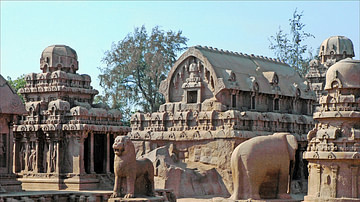
Mahabalipuram
Mahabalipuram or Mamallapuram is a historic city and UNESCO World Heritage site in Tamil Nadu, India. During the reign of the Pallava dynasty, between the 3rd century CE and 7th century CE, it became an important centre of art...

Article
Tibetan Sand Mandalas
Tibetan sand mandalas are works of art created to encourage healing, peace, and purification generally as well as spiritual or psychological focus specifically for those creating and viewing it. A mandala (Sanskrit for "circle"...

Article
Observatories in the Scientific Revolution
The foundation of observatories during the Scientific Revolution (1500-1700) followed a process of evolution from entirely independent observatories operated by a single astronomer to private observatories...

Article
Upanishads: Summary & Commentary
The Upanishads are among the best-known philosophical-religious works in the world and also among the oldest as the earliest texts are thought to have been composed between 800-500 BCE. These works are philosophical...

Definition
Dhammapada
Tipitaka (Sansktrit: Tripitaka), the Buddhist canon, consists of three pitaka (Tri means three and Pitaka refers to boxes), namely Vinaya or Monastic regimen, Sutta (Sanskrit: Sutra) or Discourses and Abhidhamma (Sanskrit: Abhidharma...
