
Search
Remove Ads
Advertisement
Search Results

Image
Statue of a Girl Playing Knucklebones
The motif of the seated young girl dates back to a late Hellenistic model, which in the Roman version, was supplemented by the game gesture. The knucklebones (astragalus) game are often also depicted on funerary...

Image
Dion Monument of the Shields, Greece
The Monument of the Shields in Dion (Greece) is a monument alternating panels of shields and breastplates. These panels come from a frieze originally carved in the 4th century BCE for an unknown monumental Hellenistic...

Image
Roman Province Bithynia et Pontus c. 200 CE
The Roman province of Bithynia et Pontus, established in 63 BCE after the defeat of Mithridates VI of Pontus, was a prosperous and strategically significant region by 200 CE. Located in northern Anatolia...
Image
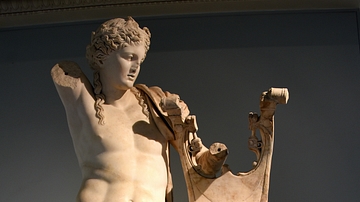
Apollo Holding a Kithara
In this elaborately carved figure, the iconographical features of both Apollo and Dionysos, the wine god, have been fused.; the slipping himation and the sensual treatment of the flesh are typical of Dionysos, while the...

Image
Memorial to Deceased Roman Cavalryman
All that remains of this stone memorial is a portrait of the deceased Roman cavalryman. The prototype of this kind of portrait can be traced to Hellenistic Greece. This memorial was found in Cologne, Germany and...
Image
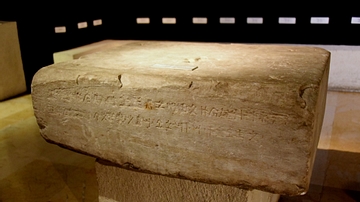
Inscribed Base of a Statue from Palaepaphos
There are two lines of inscription on this marble stone, which read: "Nikokles, King of Paphos, Wanassa Priest King, Son of Timarkhos, erected for goddess". Early Hellenistic Period, end of the 4th...

Image
The Stadium of Nysa
The Stadium of Nysa, built at the foot of the gorge with rows of seats cut into the steep hillside and dated to Late Hellenistic period.

Image
Tombs of the Kings, Cyprus [Tomb No 5]
Tomb No 5 of the Tombs of the Kings archaeological site in Cyprus. It had a colonnaded atrium and was one of the largest tombs discovered in the necropolis covering an area of 390 square metres. This fascinating...

Image
Statue of a Boy with Thorn
The figure type of the Spinario (boy with a thorn) originated in Hellenistic art of the late 3rd century BCE. The popular genre motif of the shepherd or peasant boy is conveyed in several versions and different materials...
Image
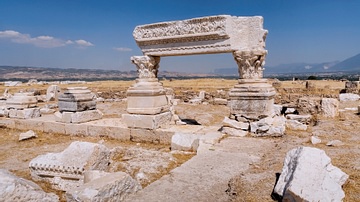
Remains of Ancient Monument in Laodicea
Most of the ruins seen in Laodicea on the Lycus in Phrygia (Turkey) today belong to the Hellenistic, Roman, and Byzantine periods.
