
Search
Remove Ads
Advertisement
Search Results

Article
The Rise of the Christian Cult of the Saints - Relics, Tombs, and Pilgrimages
Many world religions have elevated individuals with the title of "saint," which often simply means "pious one," "devout," or "holy one." The reference is to their moral lifestyle...
Article
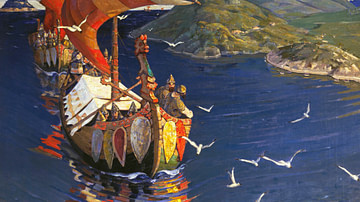
Trade & Warfare in the Kievan Rus
Scandinavians from the island of Gotland began to spread throughout the Baltic region along the Russian rivers in the 700s. While the Vikings of Norway and Denmark from the 8th to 11th centuries are widely recognized...

Article
The Role of Women in the Roman World
The exact role and status of women in the Roman world, and indeed in most ancient societies, has often been obscured by the biases of both ancient male writers and 19-20th century CE male scholars, a situation...

Article
Reforms of Catherine the Great
Catherine II of Russia (Catherine the Great) was the empress regent of Russia from 1762 to 1796. During the mid-18th century, Russia was still regarded as culturally behind compared to Western European countries. However...

Article
The Ideal of Christendom in the Middle Ages & Beyond
The ideal of Christendom in antiquity joined separate nations into one single community carrying out the precepts of the God of Israel. Constantine's conversion to Christianity resulted in the merging...
Image
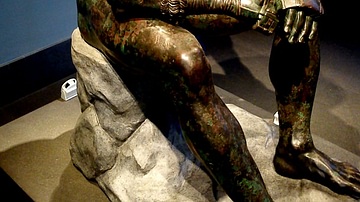
Boxer of Quirinal
The bronze Boxer of Quirinal, also known as the Terme Boxer, is a Hellenistic Greek sculpture dated around 330 BCE of a sitting boxer with Caestus, a type of leather hand-wrap, in the collection of the National Museum of Rome...

Image
Map of the Ptolemaic Kingdom of Egypt c. 240 BCE - Power, Wealth, and Rivalry in the Hellenistic World
By c. 240 BCE, Ptolemaic Egypt stood as one of the most powerful and stable successor states of Alexander’s empire, reaching a high point under Ptolemy III Euergetes...

Article
The Roman Empire in West Africa
At its fullest extent, the Roman Empire stretched from around modern-day Aswan, Egypt at its southernmost point to Great Britain in the north but the influence of the Roman Empire went far beyond even the borders of...

Article
Ancient Greek Clothing
Ancient Greek clothing developed from the Minoan Civilization of Crete (2000-1450 BCE) through the Mycenean Civilization (1700-1100 BCE), Archaic Period (8th century to c. 480 BCE) and is most recognizable from the Classical...

Article
Roman Students in Athens
Training in oratory was a crucial part of Roman education; it was associated with a young boy's transition into adult life. As Athens was considered the intellectual centre of the eastern Mediterranean, many students undertook...
