
Search
Remove Ads
Advertisement
Search Results

Article
Sanctuary of Fortuna Primigenia at Palestrina
The Sanctuary of Fortuna Primigenia at Palestrina (ancient Praeneste) in Italy was built in the 2nd century BCE to honor the goddess Isis and the goddess Fortuna. The massive site spans a mountainside...

Article
Athena Parthenos by Phidias
The magnificent temple on the Acropolis of Athens, known as the Parthenon, was built between 447 and 432 BCE in the Golden Age of Pericles, and it was dedicated to the city's patron deity Athena. The temple was constructed...

Article
Ai Khanum, the Capital of Eucratides
Ai Khanum (also spelled Ai-Khanoum or Ay-Khanum, lit. “Lady Moon” in Uzbek), was founded in the 4th century BC, following the conquests of Alexander the Great and was one of the primary cities of the Greco-Bactrian...

Article
Letters & Post in the Ancient World
Letters and their delivery via a state communication system was a feature of many ancient cultures. The writing medium may have differed but the Mesopotamians, Egyptians, Greeks, Romans, and Incas all had the means...

Article
Rome's Egyptian Heritage
The Eternal City of Rome is one of the places in the world with the most historical sites to visit. The list of ancient ruins, museums, churches, and other historical landmarks makes the city an Eldorado for anyone interested...
Article
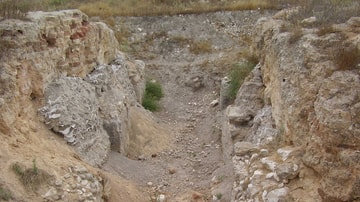
The History of Excavations at Tel Gezer
The archaeological site of Tel Gezer is located in central Israel at the edge of the western mountains near the Shephelah, about 9 or 10 km southwest of the city of Ramleh. Gezer was one of the famed "Solomonic"...
Image
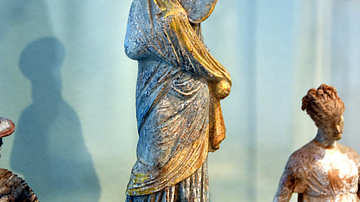
Tanagra Figurine
This small terracotta figurine is part of the so-called "Tanagra Figurines", which represent wealthy middle-class women. These statuettes served as votive and funerary objects, carrying a symbolic meaning connected with the status...

Image
Pyrrhus of Epirus
This Roman marble bust from c. 50 - 25 BCE is a copy of a Hellenistic statue made in 290 BCE. It depicts Pyrrhus king of Epirus, best known today for the phrase "Pyrrhic victory." It is currently housed at the Metropolitan Museum...
Image
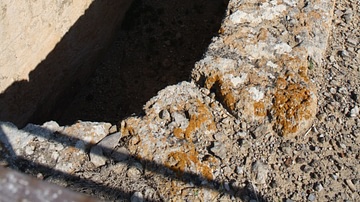
Cistern, Empuries
A Hellenistic cistern at Empuries (Emporiae), Spain. 2nd century BCE.

Image
Roman Lead Weight Decorated with Cornucopia
This lead weight was decorated with a terminal figure, cornucopia (horn of plenty), and an ear of barley. The weight is dated to the 4th year of a Hellenistic king. It is a standard mna (half stater) of a...
