
Search
Remove Ads
Advertisement
Search Results
Image
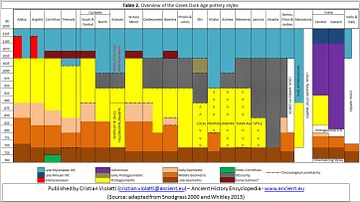
Table 2 - Overview of the Greek Dark Age pottery styles
Overview of the different pottery styles found in Greece between 1050 BC to 700 BC.
Image
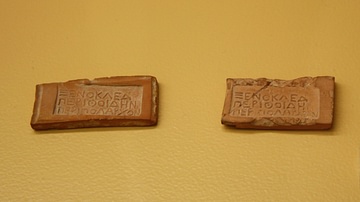
Greek Clay Passport Tokens
Clay tokens probably used as passports by travellers or messengers reporting between military headquarters. Belonging to Xenokles, a border commander, 4th century BCE. (Agora Museum, Athens)

Image
Greek Chariot
A depiction of a chariot with charioteer on an attic black-figure kylix (510-500 BCE). Olympia Archaeological Museum.

Image
Greek Athlete With Strigil
Red figure skyphos or cup (410 BCE) depicting a nude athlete holding a strigil - used to clean the body of oil, dust and sweat after exercise. To the left is possibly a mid-race marker post. Attributed to the Amykos painter...

Image
Greek Trireme Model
A model of a trireme from ancient Greece. (Archaeological Museum, Hania, Crete)
Image
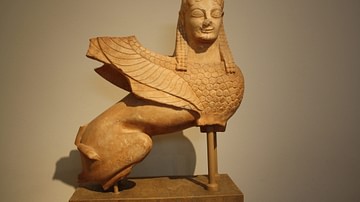
Greek Funerary Sphinx
A sphinx in pentelic marble, from a funerary stele, c. 570 BCE.
National Archaeological Museum, Athens.

Image
Greek Foot Race
Attic black-figure column crater depicting a foot race (510-500 BCE). Olympia Archaeological Museum.
Image
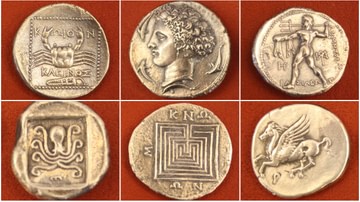
Greek Coins
Top row (L to R): Cos (300-190 BCE) Silver tetradrachm, crab. Syracuse (c. 400 BCE) - Silver decadrachm, head of Arethousa with dolphins. Macedon (306-283 BCE) - Silver tetradrachm, Poseidon with trident. Bottom row (L to...
Image
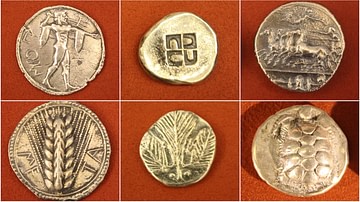
Greek Silver Coins
Top row (L to R): Poseidonia (520 BCE) - Silver stater, Poseidon with trident. Corinth (525-500 BCE) - Silver stater, incuse square of swastika design. Syracuse (c. 400 BCE) - Silver decadrachm, quadriga with Nike crowning...
Image
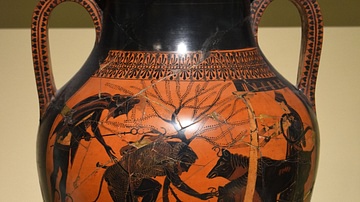
Black Figured Greek Amphora
This black figured amphora was made by the Andokides Painter of Attica, and it dates from c. 530 BCE. It is made of clay and special glaze. (Pushkin Museum, Moscow)
