
Search
Remove Ads
Advertisement
Search Results

Definition
Reign of Terror
The Reign of Terror, or simply the Terror (la Terreur), was a climactic period of state-sanctioned violence during the French Revolution (1789-99), which saw the public executions and mass killings of thousands of counter-revolutionary...

Definition
Millard Fillmore - The Forgotten US President
Millard Fillmore (1800-1874) was the thirteenth president of the United States. A member of the Whig Party, he was elected vice president in 1849 and assumed the presidency the following year after the death...

Definition
Athens
Athens, Greece, with its famous Acropolis, has come to symbolize the whole of the country in the popular imagination, and not without cause. It not only has its iconic ruins and the famous port of Piraeus but, thanks to ancient writers...

Definition
Euripides
Euripides (c. 484-407 BCE) was one of the greatest authors of Greek tragedy. In 5th century BCE Athens his classic works such as Medeia cemented his reputation for clever dialogues, fine choral lyrics and a gritty realism in both his...

Definition
Atlantis
Atlantis is a legendary city described by the Greek philosopher Plato (c. 429 – 347 BCE). Atlantis, a fabulously wealthy and advanced civilization, was swept into the sea and lost forever in a story which has captured the imagination...

Article
Roman Warfare in the Age of Pyrrhus
The Roman army fought many conflicts throughout its long history, though perhaps none so indelible as the Pyrrhic War from 280 to 275 BCE. This war between Rome and a league of Greek colonies in southern Italy...

Image
Greek Lead Weights
Standard lead weights from the agora of Athens. 5th-2nd century BCE. (Agora Museum, Athens)

Image
Greek Glass Amphoriskos from Amman
An amphoriskos is a small amphora, typically less than 4 inches in height. Polychrome and sand-core formed. The decoration and the technique used are very similar to Phoenician glass, reflecting the trade and cultural...

Image
Eschara (Greek Brazier)
A shallow brazier (eschara) in terracotta with metal spits. 6th-4th century BCE. (Agora Museum, Athens)
Image
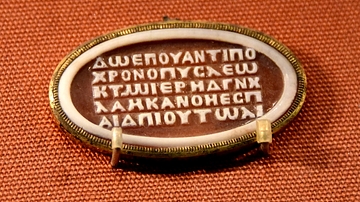
Sardonyx Cameo Showing Nonsense Greek Inscription
Skillful Roman cameo-carvers exploited the tonal contrast of some stones. This could be a simple two-tone contrast or a more subtle variation using all available gradations of shade. Sardonyx was particularly...
