
Search
Remove Ads
Advertisement
Search Results

Definition
Hestia
Hestia was the Greek virgin goddess of the hearth, home, and hospitality. In Greek mythology, she is the eldest daughter of Cronus and Rhea. In her role as a protector of the family and political community, sacrifices and offerings were...

Definition
Ark of the Covenant
The Ark of the Covenant refers to the box-like container that held the tablets of the Law received by Moses on Mount Sinai. Tradition claimed that it contained two stone tablets, carved by God, listing the first ten commandments...

Definition
Philosophy
The word philosophy comes from the Greek philo (love) and sophia (wisdom) and so is literally defined as “the love of wisdom”. More broadly understood, it is the study of the most basic and profound matters of human existence. Philosophical...

Definition
Magna Graecia
Magna Graecia (Megalē Hellas) refers to the coastal areas of southern Italy which were colonized by various ancient Greek city-states from the 8th to 5th centuries BCE. Sicily, although also a region of Greek colonization, is not...

Definition
Theogony
The Theogony is an 8th-century BCE didactic and instructional poem, credited to the Greek poet Hesiod. The Theogony was, at first, not actually written down, rather, it was part of a rich oral tradition which only achieved written form...
Definition
Lyre
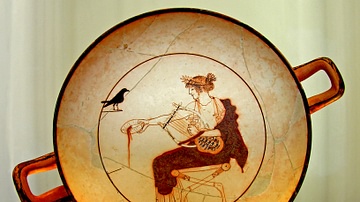
The lyre was a stringed musical instrument played by the ancient Greeks. It was probably the most important and well-known instrument in the Greek world. The lyre was closely related to the other stringed instruments: the chelys which...
Definition
Bacchae
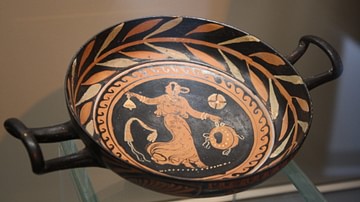
The Bacchae is a Greek tragedy written by the playwright Euripides (c. 484-406 BCE) in 407 BCE, which portrays Pentheus as an impious king, for the ruler of Thebes has denied the worship of Dionysus within his city walls. For Pentheus...

Definition
Roman Sculpture
Roman sculpture blended the idealised perfection of Classical Greek sculpture with a greater aspiration for realism. It also absorbed artistic preferences and styles from the East to create images in stone and bronze which rank...

Definition
Etruscan Art
The art of the Etruscans, who flourished in central Italy between the 8th and 3rd century BCE, is renowned for its vitality and often vivid colouring. Wall paintings were especially vibrant and frequently capture scenes of Etruscans...

Definition
Mystras
The city of Mystras (or Mistras) in southern Greece was the provincial capital of the Byzantine Despotate of the Morea from the 13th through the 15th centuries CE. It was founded in 1249 CE by William II of Villehardouin, and it served...
