
Search
Remove Ads
Advertisement
Search Results

Definition
Ur-Nammu - Founder of the Sumerian Renaissance
Ur-Nammu (circa 2112-2094 BCE) was the founder of the Third Dynasty of Ur in Sumer, who initiated the so-called Ur III period (circa 2112 to circa 2004 BCE), also known as the Sumerian Renaissance. He is...

Definition
Ancient Egyptian Vizier
The vizier in ancient Egypt was the most powerful position after that of king. Known as the djat, tjat, or tjati in ancient Egyptian, a vizier was the equivalent of the modern-day prime minister of the nation who actually...

Definition
Assignat
The assignat was a paper bill issued by France between 1789 and 1796, during the French Revolution (1789-1799). First issued in the form of bonds, the assignat was meant to stimulate France's economy as a quick means to pay off national...

Definition
Festival of the Federation
The Festival of the Federation (Fête de la Fédération) was a celebration that occurred on the Champ de Mars outside Paris on 14 July 1790, the first anniversary of the Storming of the Bastille. With over 300,000 people...

Definition
Utilitarianism
Utilitarianism is a philosophy founded by Jeremy Bentham (1748-1832) and then extended by other thinkers, notably John Stuart Mill (1806-1873). Utilitarianism involves the greatest happiness principle, which holds that a law or...
Definition
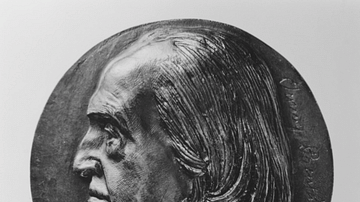
Jeremy Bentham
Jeremy Bentham (1748-1832) was an English philosopher and liberal social reformer best known as the founder of utilitarianism based on the greatest happiness principle, that is, rationally judging the success of a law by considering...
Definition
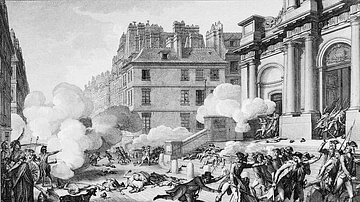
13 Vendémiaire
The Revolt of 13 Vendémiaire Year IV (5 October 1795) was a royalist uprising in Paris during the French Revolution (1789-1799). In response to the anti-royalist policies of the Thermidorian Reaction, 25,000 Parisians rose in revolt...

Definition
Battle of the Granicus
The Battle of the Granicus in May 334 BCE was Alexander the Great's (356-323 BCE) first major victory against the forces of the Achaemenid Empire. Alexander had crossed the Hellespont with his combined Macedonian and Greek...
Definition
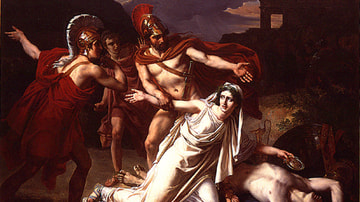
Antigone
Antigone was the third play in the Oedipus trilogy written by the great Greek playwright Sophocles (c. 496 - c. 406 BCE). Produced around 441 BCE and receiving first prize at the Dionysia festival, the tragedy was actually written long...

Definition
Aristophanes
Aristophanes (c. 460 - c. 380 BCE) was the most famous writer of Old Comedy plays in ancient Greece and his surviving works are the only examples of that style. His innovative and sometimes rough comedy could also hide more sophisticated...
