
Search
Remove Ads
Advertisement
Search Results

Definition
Antoine de Chandieu
Antoine de Chandieu (l. 1534-1591) was a French theologian, who played a decisive role in the religious history of the 16th century but remains in the shadow of other French Protestant leaders. Due to his remarkable abilities...

Definition
Acropolis
An acropolis is any citadel or complex built on a high hill. The name derives from the Greek akro, "high" or "extreme/extremity" or "edge", and polis, "city", translated as "high city", "city on the edge" or "city in the air", the...

Definition
Mauryan Empire
The Mauryan Empire (322 BCE - 185 BCE) supplanted the earlier Magadha Kingdom to assume power over large tracts of eastern and northern India. At its height, the empire stretched over parts of modern Iran and almost the entire...

Definition
Lumbini
Lumbini is a village, archaeological site, and place of pilgrimage honored as the birthplace of Siddhartha Gautama (the Buddha, l. c. 563-483 BCE) located in modern-day Rupandehi District of Nepal, Province 5, near the Indian border...

Definition
Canaan
Canaan was the name of a large and prosperous ancient country (at times independent, at others a tributary to Egypt) located in the Levant region of present-day Lebanon, Syria, Jordan, and Israel. It was also known as Phoenicia. The origin...

Definition
Charles V, Holy Roman Emperor
Charles V, Holy Roman Emperor (24 February 1500 to 21 September 1558) reigned from 1519 until his abdication in 1556 and was one of the most powerful rulers in the history of the Habsburg dynasty. Through a series of...

Definition
Baalbek
Baalbek is an ancient Phoenician city located in what is now modern-day Lebanon, north of Beirut, in the Beqaa Valley. Inhabited as early as 9000 BCE, Baalbek grew into an important pilgrimage site in the ancient world for the worship...
Definition
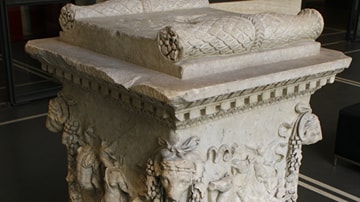
Roman Religion
In many societies, ancient and modern, religion has performed a major role in their development, and the Roman Empire was no different. From the beginning Roman religion was polytheistic. From an initial array of gods and spirits...

Definition
Telesilla of Argos
Telesilla of Argos was a lyric poet of the 5th century BCE, listed by Antipater of Thesalonike (c. 15 BCE) as one of the great Nine Female Lyric Poets of Greece (along with Praxilla, Moiro, Anyte, Sappho, Erinna, Corinna, Nossis...

Definition
Assembly of Notables of 1787
The meeting of the Assembly of Notables in 1787 was a last-ditch effort by the ministers of King Louis XVI of France (r. 1774-1792) to fix the disastrous condition of French finances. The assembly failed to agree on...
