
Search
Remove Ads
Advertisement
Search Results

Definition
Temple at Uppsala
The Temple at Uppsala was a religious center dedicated to the Norse gods Thor, Odin, and Freyr located in what is now Gamla Uppsala in Sweden. It is described by the 11th-century historian Adam of Bremen as the most significant...

Definition
Jerusalem
Jerusalem is a major holy city for the three Western traditions of Judaism, Christianity, and Islam. It sits on spurs of bedrock between the Mediterranean Sea and the Dead Sea area. To the north and west, it tapers off to the Jezreel...

Article
Old Testament Pseudepigrapha
The Old Testament Pseudepigrapha are the non-canonical writings of Judaism and Christianity, ranging from the 5th century BCE to the 9th century CE. Pseudepigrapha comes from a Greek noun denoting writings with a false...
Definition
Acts of the Apostles
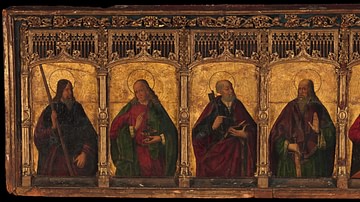
The Acts of the Apostles is the story of how the movement that became Christianity began in Jerusalem and spread throughout the Eastern Mediterranean cities of the Roman Empire. It was written by the same author as the third...

Definition
Mithra
Mithra is the Persian god of the rising sun, contracts, covenants, and friendship. He also oversaw the orderly change of the seasons, maintained cosmic order, and was responsible for bestowing divine grace on kings, legitimizing their...

Definition
Ancient Egyptian Culture
Ancient Egyptian culture flourished between c. 6000 BCE with the rise of technology (as evidenced in the glasswork of faience) and 30 BCE with the death of Cleopatra VII, the last Ptolemaic ruler of Egypt. It is famous...

Definition
Cilicia
Cilicia is the ancient Roman name for the southeastern region of Asia Minor (modern-day Turkey). It is referenced in the biblical books of Acts and Galatians, was the birthplace of Saint Paul, and the site of his early evangelical missions...

Definition
Vikings
The Vikings were originally diverse Scandinavian seafarers from Norway, Sweden, and Denmark (though other nationalities were later involved) whose raids and subsequent settlements significantly impacted the cultures of Europe and were...

Definition
Europe
Europe is a continent forming the westernmost part of the land mass of Eurasia and comprised of 49 sovereign states. Its name may come from the Greek myth of Europa, but human habitation of the region predates that tale, going back over...

Definition
Edward Gibbon
Edward Gibbon (1737-1794) was an English historian most famous for his influential work The History of the Decline and Fall of the Roman Empire, volume one of which was published in 1776, with the final sixth volume coming in 1788...
