
Search
Remove Ads
Advertisement
Search Results

Definition
Nikephoros II Phokas
Nikephoros II Phokas was Byzantine emperor from 963 to 969 CE. Known as “White Death of the Saracens,” Nikephoros was a fearsome commander who conquered Crete, Cilicia, and much of Syria. While he is known as a great military...
Definition
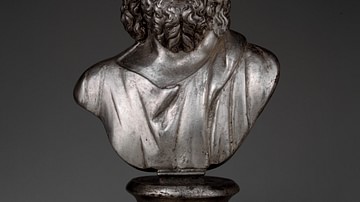
Serapis
Serapis is a Graeco-Egyptian god of the Ptolemaic Period (323-30 BCE) of Egypt developed by the monarch Ptolemy I Soter (r. 305-282 BCE) as part of his vision to unite his Egyptian and Greek subjects. Serapis’ cult later spread throughout...

Definition
Carthage
Carthage was a Phoenician city-state on the coast of North Africa (the site of modern-day Tunis) which, prior the conflict with Rome known as the Punic Wars (264-146 BCE), was the largest, most affluent, and powerful political entity...

Definition
Chrocus
Chrocus (Crocus) was a king of the Alemanni who invaded Roman Gaul c. 256 CE until he was defeated by the Roman legions at Arles and then executed. Conversely, he was a king of the Alemanni who served Rome and supported Constantine the...

Definition
Dodekaschoinos
The Dodekaschoinos (literally "Twelve Cities" in Greek) was the name of a region in Lower Nubia that became an important province of the Ptolemaic Kingdom after it was annexed from Meroitic Nubia by the Egyptian kingdom. The area...

Definition
Vagharshapat
Vagharshapat (Valarsapat), located some 20 km west of modern Yerevan, was an ancient city in Armenia founded in the 2nd century CE. Serving as the capital, the city prospered and, under the new name of Echmiadzin, became the spiritual...

Article
Trade in Ancient Mesopotamia - How Commerce Encouraged Civilization
Local trade in ancient Mesopotamia began in the Ubaid period (circa 6500-4000 BCE), had developed into long-distance trade by the Uruk period (circa 4000-3100 BCE), and was flourishing by...

Definition
Loki
Loki is a god in Norse mythology who is often simply described as the 'trickster' god for his love of playing pranks on both his fellow gods and his or their opponents. Sworn brother of Odin and often the one to dig the other gods out...
Definition
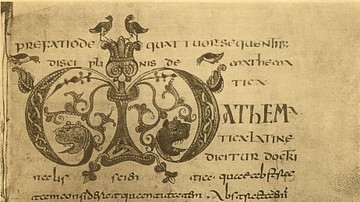
Etymologiae
The Etymologiae (Etymologies) is a Latin work by Isidore of Seville (l. c. 560 - 636 CE), compiled in the early 7th century CE and published in its final form shortly after his death. The book is a type of medieval encyclopedia and...
Definition
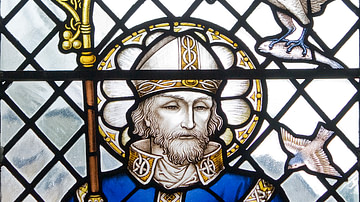
Saint Cuthbert
Saint Cuthbert (c. 634 - 20 March 687) was an Anglo-Saxon monk from the Kingdom of Northumbria, who became the bishop of Lindisfarne and one of the most important saints of the medieval church in England. He first became a monk...
