
Search
Remove Ads
Advertisement
Search Results

Definition
Ancient Britain
Ancient Britain was a landmass on the northwest of the continent of Europe first occupied by humans c. 800,000 years ago prior to it becoming an island c. 6000 BCE due to flooding which separated it from the mainland. Agriculture...

Definition
Gildas
Gildas (c. 500-570 CE) was a Romano-British monk, known primarily for a work entitled De Excidio et Conquestu Britanniae, translated as On the Ruin and Conquest of Britain. Gildas' work is a polemical sermon recounting British history...
Definition
Beowulf
Beowulf is an epic poem composed in Old English consisting of 3,182 lines. It is written in the alliterative verse style, which is common for Old English poetry as well as works written in languages such as Old High German, Old Saxon...

Definition
Saint Columbanus
Saint Columbanus or “Columbán” (543-615 CE) was one of the greatest missionaries of the early Catholic Church who led the “Hiberno-Scottish mission” of conversion across much of what is now Western Europe in the late 6th and early...

Definition
Baal
Baal (also given as Ba'al) is a Canaanite-Phoenician god of fertility and weather, specifically rainstorms. The name was also used as a title, however, meaning "Lord" and was applied to a number of different deities throughout the ancient...

Definition
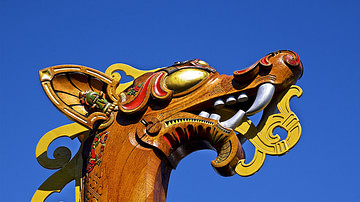
Viking Art
Art made by Scandinavians during the Viking Age (c. 790-1100 CE) mostly encompassed the decoration of functional objects made of wood, metal, stone, textile and other materials with relief carvings, engravings of animal shapes and...

Definition
Kingdom of Wessex
The Kingdom of Wessex (c. 519-927 or c. 519-1066) was a political entity founded by the West Saxon Chieftain Cerdic (r. 519-540) in 519 in the Upper Thames Valley of modern-day Britain which would later evolve into the modern...

Definition
Galen
Galen (129-216 CE) was a Greek physician, author, and philosopher, working in Rome, who influenced both medical theory and practice until the middle of the 17th century CE. Owning a large, personal library, he wrote hundreds of medical...

Definition
Agora
The term agora (pronounced ah-go-RAH) is Greek for 'open place of assembly' and, early in the history of Greece, designated the area in a city where free-born citizens could gather to hear civic announcements, muster for military campaigns...
Definition
Slavs
The term "Slavs" designates an ethnic group of people who share a long-term cultural continuity and who speak a set of related languages known as the Slavic languages (all of which belong to the Indo-European language family). Little...
