
Search
Remove Ads
Advertisement
Search Results

Definition
Gymnasium - The Ancient Greek Building for Sport & Study
The Gymnasium was a Greek building originally used for athletic activities but which came, over time, to be used also as a place of study and philosophical discussion. In the Hellenistic Period...

Definition
Sappho of Lesbos
Sappho of Lesbos (l. c. 620-570 BCE) was a lyric poet whose work was so popular in ancient Greece that she was honored in statuary, coinage, and pottery centuries after her death. Little remains of her work, and these fragments...

Definition
Etymologiae
The Etymologiae (Etymologies) is a Latin work by Isidore of Seville (l. c. 560 - 636 CE), compiled in the early 7th century CE and published in its final form shortly after his death. The book is a type of medieval encyclopedia and...

Video
The Development of Ancient Greek Architecture
Some of the most exceptional and distinctive buildings from the ancient world were crafted by the architects of ancient Greece and some of their structures like theatres, temples, and stadia became staple...

Article
Spartan Women
Spartan women had more rights and enjoyed greater autonomy than women in any other Greek city-state of the Classical Period (5th-4th centuries BCE). Women could inherit property, own land, make business transactions, and were better...

Definition
Bacchus
Bacchus was the god of wine and revelry in Roman mythology. Considered the most versatile and elusive of the gods, with a Greek equivalent in Dionysus, Bacchus is frequently associated with the Roman god of wine Liber Pater. He brought...

Definition
Aristarchus of Samos
Aristarchus of Samos (l. c. 310 - c. 230 BCE) was a Greek astronomer who first proposed a heliocentric model of the universe in which the sun, not the earth, was at the center. Although his theory was noted by other thinkers...
Definition
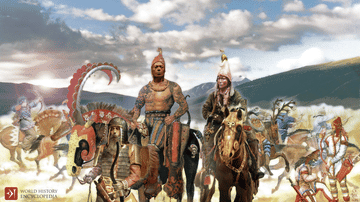
Scythians
The Scythians were a nomadic people whose culture flourished between the 7th and 3rd century BCE in a territory ranging from Thrace in the west, across the steppe of Central Asia, to the Altai Mountains of Mongolia in the east. This...
Definition
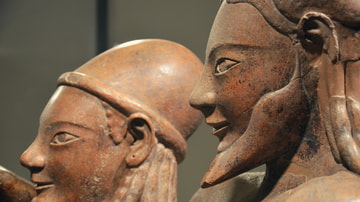
Etruscan Civilization
The Etruscan civilization flourished in central Italy between the 8th and 3rd century BCE. The culture was renowned in antiquity for its rich mineral resources and as a major Mediterranean trading power. Much of its culture...

Definition
Symposium - The Drinking Party of Ancient Greece
The symposium (or symposion) was an important part of ancient Greek culture from the 7th century BCE and was a party held in a private home where Greek males gathered to drink, eat and sing together. Various...
