
Search
Remove Ads
Advertisement
Search Results

Article
Ancient Greek Inventions
The ancient Greeks are often credited with building the foundations upon which all western cultures are built, and this impressive accolade stems from their innovative contributions to a wide range of human activities...

Definition
Leonardo da Vinci
Leonardo da Vinci (1452-1519) was an Italian Renaissance artist, architect, engineer, and scientist. He is renowned for his ability to observe and capture nature, scientific phenomena, and human emotions in all media. Leonardo’s...

Definition
Theogony
The Theogony is an 8th-century BCE didactic and instructional poem, credited to the Greek poet Hesiod. The Theogony was, at first, not actually written down, rather, it was part of a rich oral tradition which only achieved written form...

Definition
Mythology
Myths are a part of every culture in the world and are used to explain natural phenomena, where a people came from and how their civilization developed, and why things happen as they do. At their most basic level, myths comfort by...

Definition
Hercules
Hercules (Herakles) was a hero of Greek mythology famous for his great strength and endurance. Celebrated as an extraordinary mortal, his success in seemingly impossible labours won him an immortal place amongst the gods. As the greatest...

Definition
Kami
In the Shinto religion kami is an all-embracing term which signifies gods, spirits, deified mortals, ancestors, natural phenomena, and supernatural powers. All of these kami can influence people's everyday lives and so they are worshipped...

Definition
Hypatia of Alexandria
Hypatia of Alexandria (c. 370 - March 415) was a female philosopher and mathematician, born in Alexandria, Egypt possibly in 370 (although some scholars cite her birth as c. 350). Little is known of her life but her dramatic...

Definition
Nasta 'liq
Nasta 'liq is one of the styles of Islamic calligraphy that was developed on Persian grounds by Persian calligraphers. The art of calligraphy has always held a prominent position in Persia, and its usage extends beyond the limits...
Definition
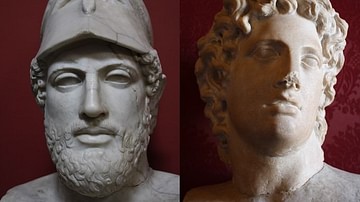
Plutarch
L. Mestrius Plutarchus, better known simply as Plutarch, was a Greek writer and philosopher who lived between c. 45-50 CE and c. 120-125 CE. A prodigious and hugely influential writer, he is now most famous for his biographical works...

Definition
Ancient Egyptian Literature
Ancient Egyptian literature comprises a wide array of narrative and poetic forms including inscriptions on tombs, stele, obelisks, and temples; myths, stories, and legends; religious writings; philosophical works; wisdom...
