
Search
Remove Ads
Advertisement
Search Results

Definition
Ancient Korean Coinage
The coinage of ancient Korea (pre-13th century CE) first employed Chinese coins, known locally as the oshuchon. Korean rulers began minting their own metal coins from the late 10th century CE, first in copper and iron, and...

Image
A Chinese Servant Statue
A servant statue, Western Han Period (206 BCE – 9 CE). Cernuschi Museum, Paris, France.

Article
The Art of the Tang Dynasty
The art of the Tang Dynasty (618-907 CE) began to explore new possibilities in materials and styles with landscape painting and ceramics, in particular, coming to the fore. New techniques, a wider range of colours and...

Article
The Impact of Prejudice on the History of Great Zimbabwe
Between 850 BCE and 1600 CE, great civilizations thrived in Africa, yet few non-Africans have learned about them. While some may be familiar with the achievements of ancient Egypt, most of our knowledge...

Article
10 Years of World History Encyclopedia
Our CEO Jan van der Crabben writes about the organization's history for its 10th anniversary in 2019 (when it was still called Ancient History Encyclopedia). Ancient History Encyclopedia just turned ten! On...

Definition
Jade Emperor
The Supreme August Jade Emperor is the supreme deity of Chinese tradition and is otherwise known as Yuhuang Shangdi (Yu-huang Shang-ti), Yudi (Yu Ti) or Mr. Heaven (Lao-t'ien ye). He governs the cosmos and resides in a magnificent...

Image
Traditional Chinese Roof Tiles & Acroteria
A detail of a roof from the Forbidden Cty, Beijing. In ancient Chinese architecture the yellow tiles, curved roof, and dragon acroteria were all typical features of imperial buildings.
Image
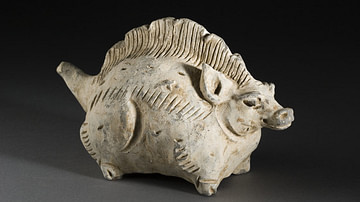
Chinese Pig-Dragon Sculpture
A Chinese pig-dragon sculpture. China, probably Yunnan Province, Yuan dynasty, 1279-1368.
Los Angeles County Museum of Art.

Video
History of the Holidays: History of Thanksgiving | History
Although Thanksgiving celebrations dated back to the first European settlements in America, it was not until the 1860s that Abraham Lincoln declared the last Thursday of November to be a national...
Definition
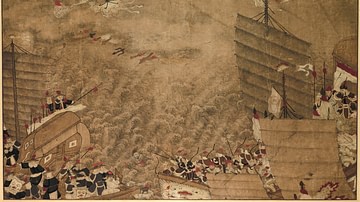
Wako - The Medieval Pirates of Southeast Asia
Wako (aka wokou and waegu) is a term used to refer to Japanese (but also including Chinese, Korean, and Portuguese) pirates who plagued the seas of East Asia from Korea to Indonesia, especially between the...
