
Search
Remove Ads
Advertisement
Search Results

Definition
Yongle Emperor
The Yongle Emperor (aka Chengzu or Yung Lo, r. 1403-1424 CE) was the third ruler of the Chinese Ming Dynasty (1368-1644 CE). Inheriting a stable state thanks to the work of his father, the Hongwu Emperor (r. 1368-1398 CE), Yongle...

Article
The Seven Voyages of Zheng He
Admiral Zheng He (aka Cheng Ho, c. 1371-1433 CE) was a Chinese Muslim eunuch explorer who was sent by the Ming dynasty emperor Yongle (r. 1403-1424 CE) on seven diplomatic missions to increase trade and secure tribute...

Definition
Zheng Yi
Zheng Yi (also Cheng I, Ching Yih, Cheng Yao-I, Cheng Wen-Hsien, or Cheng Yud) was a Chinese pirate who lived from 1765 to 1807. Operating in the South China Sea, Zheng Yi famously led a 600-ship pirate confederation. This force of...

Definition
Wu Zetian
Empress Wu Zetian (Empress Consort Wu, Wu Hou, Wu Mei Niang, Mei-Niang, and Wu Zhao, l. 624-705 CE, r. 690-704 CE) was the only female emperor of Imperial China. She reigned during the Tang Dynasty (618-907 CE) and was one of the most...

Article
Most Popular Gods & Goddesses of Ancient China
There were over 200 gods and goddesses worshipped throughout ancient China, but if one were to count every deity or spirit, the number would be over 1,000. Each town, village, city, field, farm, and sometimes...

Definition
Emperor Gaozu of Tang
Emperor Gaozu (also Kao-tsu, formerly Li Yuan, r. 618-626 CE) was a Sui military commander who led a rebellion against his former masters, seized control of the state, and founded the Tang Dynasty (618-906 CE). Overshadowed...

Definition
Khitan
The Khitan people formed the Liao dynasty and ruled parts of Mongolia, Manchuria, and northern China from 907 to 1125 CE. Adopting elements of Chinese government and culture, the Khitan were more than a match for their rivals the Song...

Definition
Yin and Yang
The principle of Yin and Yang from Chinese philosophy is that all things exist as inseparable and contradictory opposites. Examples of Yin-Yang opposite forces are female-male, dark-light, and old-young. The pairs of equal opposites...
Article
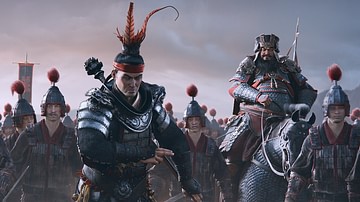
The Early Three Kingdoms Period
The Early Three Kingdoms Period in ancient China, from 184 CE to 190 CE for the purposes of this article, was one of the most turbulent in China's history. With an ailing Han government unable to control its empire...

Definition
Emperor Taizong of Tang
Taizong (birth name, Li-Shimin, l. 598-649 CE, r. 626-649 CE) was the second emperor of the Tang Dynasty and is considered one of the greatest rulers in Chinese history for his reforms of the government and the laws, his...
