
Search
Remove Ads
Advertisement
Search Results

Definition
Korean War - How the Cold War Became a Hot War
The Korean War was a Cold War conflict that took place between North and South Korea from 1950 to 1953. It pitted US-led United Nations (UN) forces against the communist bloc supported by the Soviet Union...

Interview
Interview: Rome: A History in Seven Sackings
No city on earth has preserved its past quite like Rome. Visitors stand on bridges that were crossed by Julius Caesar and Cicero, walk around temples visited by Roman emperors, and step into churches that...

Definition
Taoism
Taoism (also known as Daoism) is a Chinese philosophy attributed to Lao Tzu (c. 500 BCE) which developed from the folk religion of the people primarily in the rural areas of China and became the official religion of the country under...

Image
Chinese Terracotta Warrior
A portion of the Terracotta Army, the clay life-size army in the tomb of the Qin emperor Shi Huangdi. c. 210 BCE, Shaanxi Province, China.

Image
Chinese Dragon Roof Tile
A glazed ceramic roof tile depicting a dragon. Nanjing, Ming dynasty, 1366-1400.
The British Museum, London.

Image
Neolithic Chinese Jar
This jar dates from the 26th century BCE and is made of earthenware with pigments. It was made by the Majiayao Yangshao culture during the Banshan phase (c. 2655-2330 BCE). (Iris & B. Gerald Cantor Center for Visual Arts at...

Video
Ancient Chinese Inventions
This video describes the many inventions of ancient China extending to the Early Middle Ages, and how these innovations impacted other aspects of Chinese history.

Image
Chinese Diamond Sutra
The Buddhist text known as the Diamond Sutra is believed to be the oldest surviving printed book in the world, dated to 868 CE and written in Chinese. This work is one of the most important works of the Buddhist tradition.

Image
Chinese Eunuchs
A mural depicting a group of eunuchs, the slaves and influential advisors of many Chinese emperors. Mural from the tomb of the prince Zhanghuai, 706 CE, Qianling, Shaanxi, China.
Image
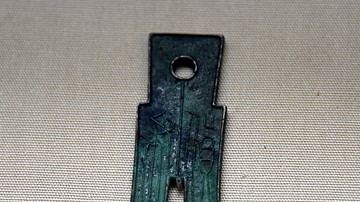
Chinese Bronze Hoe Coin
Bronze spade money (worth 25 standard coins) with Chinese inscription, minted in China under the rule of Wang Mang, Xin Dynasty, 9-23 CE. Wang Mang's four coinage reforms were not successful and the widely accepted wuzhu...
