
Search
Remove Ads
Advertisement
Search Results

Video
History of the Chinese Hungry Ghost Festival
The Hungry Ghost Festival, also known as the Ghost Festival is celebrated either on the night of the 14th or the 15th day (depending on where you live in China), of the seventh month of the lunar year, known...

Definition
Goguryeo
Goguryeo (Koguryo) was a kingdom which ruled northern Korea during the Three Kingdoms period from the 1st century BCE to 7th century CE. The kingdom flourished in the 5th and 6th century CE and has left a rich cultural heritage best...

Image
Chinese Bronze Hoe Coin
Bronze spade money (worth 25 standard coins) with Chinese inscription, minted in China under the rule of Wang Mang, Xin Dynasty, 9-23 CE. Wang Mang's four coinage reforms were not successful and the widely accepted wuzhu...

Definition
Wu Zetian
Empress Wu Zetian (Empress Consort Wu, Wu Hou, Wu Mei Niang, Mei-Niang, and Wu Zhao, l. 624-705 CE, r. 690-704 CE) was the only female emperor of Imperial China. She reigned during the Tang Dynasty (618-907 CE) and was one of the most...

Image
Chinese Bronze Mirror with Phoenix Motif
This Chinese bronze mirror with a phoenix motif dates from the Tang dynasty (618-907 CE). The phoenix was the female counterpart to the male dragon in mythology, and it was also a symbol of Chinese empresses...

Article
The Seven Voyages of Zheng He
Admiral Zheng He (aka Cheng Ho, c. 1371-1433 CE) was a Chinese Muslim eunuch explorer who was sent by the Ming dynasty emperor Yongle (r. 1403-1424 CE) on seven diplomatic missions to increase trade and secure tribute...

Definition
Ancient Korean Coinage
The coinage of ancient Korea (pre-13th century CE) first employed Chinese coins, known locally as the oshuchon. Korean rulers began minting their own metal coins from the late 10th century CE, first in copper and iron, and...

Definition
Silk in Antiquity
Silk is a fabric first produced in Neolithic China from the filaments of the cocoon of the silk worm. It became a staple source of income for small farmers and, as weaving techniques improved, the reputation of Chinese silk spread...

Article
Religious Developments in Ancient India
For well over 1,000 years, sacred stories and heroic epics have made up the mythology of Hinduism. Nothing in these complex yet colourful legends is fixed and firm. Pulsing with creation, destruction, love...
Image
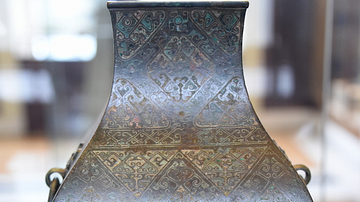
Chinese Bronze Fanghu Vessel
This ritual alcohol vessel is inlaid with malachite and copper wire. Eastern Zhou period, Warring States period, 475-221 BCE. From modern-day China. Anonymous loan. (The British Museum, London).
