
Search
Remove Ads
Advertisement
Search Results

Definition
Shang Dynasty
The Shang Dynasty (c. 1600-1046 BCE) was the second dynasty of China, which succeeded the Xia Dynasty (c. 2070-1600 BCE) after the overthrow of the Xia tyrant Jie by the Shang leader, Tang. Since many historians question whether...

Definition
Confucianism
Confucianism is a philosophy developed in 6th-century BCE China, which is considered by some a secular-humanist belief system, by some a religion, and by others a social code. The broad range of subjects touched on by Confucianism...
Definition
Zarathustra
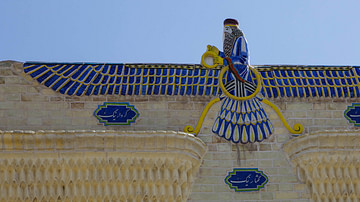
Zarathustra (also given as Zoroaster, Zartosht, Zarathustra Spitama, l. c. 1500-1000 BCE) was the Persian priest-turned-prophet who founded the religion of Zoroastrianism (also given as Mazdayasna “devotion to Mazda”), the first monotheistic...

Collection
Chinese Philosophy
Ancient Chinese Philosophy developed during the Spring and Autumn Period (c. 772-476 BCE) and the Warring States Period (c. 481-221 BCE) in ancient China. This was the era known as the Hundred Schools of Thought, referring to...

Definition
Khitan
The Khitan people formed the Liao dynasty and ruled parts of Mongolia, Manchuria, and northern China from 907 to 1125 CE. Adopting elements of Chinese government and culture, the Khitan were more than a match for their rivals the Song...

Definition
Oracle Bones
Oracle Bones (also known as Dragon's Bones) were the shoulder blades of oxen or plastrons of turtles (the flat underside of the turtle's shell) which were used in the Shang Dynasty of China (c. 1600-1046 BCE) for divination. The...

Article
Mulan: The Legend Through History
Mulan (“magnolia”) is a legendary character in Chinese literature who is best known in the modern day from the Disney filmed adaptations (1998, 2020). Her story, however, about a young girl who takes her father's...
Article
Religious Developments in Ancient India
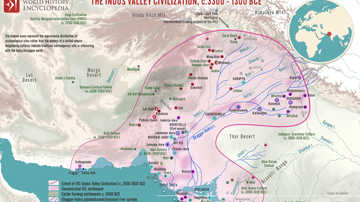
For well over 1,000 years, sacred stories and heroic epics have made up the mythology of Hinduism. Nothing in these complex yet colourful legends is fixed and firm. Pulsing with creation, destruction, love...
Definition
Yin and Yang
The principle of Yin and Yang from Chinese philosophy is that all things exist as inseparable and contradictory opposites. Examples of Yin-Yang opposite forces are female-male, dark-light, and old-young. The pairs of equal opposites...

Article
The Seven Voyages of Zheng He
Admiral Zheng He (aka Cheng Ho, c. 1371-1433 CE) was a Chinese Muslim eunuch explorer who was sent by the Ming dynasty emperor Yongle (r. 1403-1424 CE) on seven diplomatic missions to increase trade and secure tribute...
