
Search

 This answer was generated by
 Search Results

Definition
The Medieval Church
Religious practice in medieval Europe (c. 476-1500) was dominated and informed by the Catholic Church. The majority of the population was Christian, and "Christian" at this time meant "Catholic" as there was initially no other form of that...

Definition
Counter-Reformation
The Counter-Reformation (also known as the Catholic Reformation, 1545 to c. 1700) was the Catholic Church's response to the Protestant Reformation (1517-1648). It is usually dated from the Council of Trent in 1545 to the end of the Great...

Article
France’s 1905 Law of Separation of Church and State
The 1905 Law of Separation of Church and State was enacted as the climax of decades of conflict between monarchists and anticlerical Republicans who viewed Christianity as a permanent obstacle to the social development of the Republic. The...

Article
Unam Sanctam: Spiritual Authority & the Medieval Church
The Unam Sanctam (1302) was a papal bull issued by Pope Boniface VIII (served 1294-1303) requiring the complete submission of all people, including kings, to the authority and dictates of the pope. As the Church was understood as holding...

Article
Six Great Heresies of the Middle Ages
The medieval Church established its monopoly over the spiritual life of Europeans in the Early Middle Ages (c. 476-1000) and consolidated that power throughout the High Middle Ages (1000-1300) and Late Middle Ages (1300-1500). Along the way...

Definition
Bohemian Reformation
The Bohemian Reformation (c. 1380 to c. 1436) was the first concerted effort by Catholic clergy to reform the abuses and corruption of the medieval Church. Bohemian clerics and theologians called for reform and, like later advocates, initially...

Definition
Council of Trent
The Council of Trent (1545-1563) was a meeting of Catholic clerics convened by Pope Paul III (served 1534-1549) in response to the Protestant Reformation. In three separate sessions, the council reaffirmed the authority of the Catholic Church...
Definition
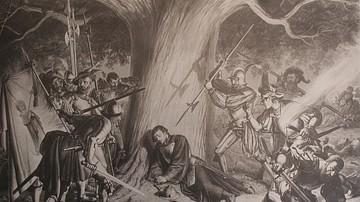
Kappel Wars
The Kappel Wars (also known as the Wars of Kappel) were armed conflicts between Protestants and Catholics in Switzerland during the Swiss Reformation. The First Kappel War ended before it began in 1529, while the second, in 1531, concluded...

Definition
John Wycliffe
John Wycliffe (l. 1330-1384, also John Wyclif) was an English theologian, priest, and scholar, recognized as a forerunner to the Protestant Reformation in Europe. Wycliffe condemned the practices of the medieval Church, citing many of the...

Definition
English Reformation
The English Reformation began with Henry VIII of England (r. 1509-1547 CE) and continued in stages over the rest of the 16th century CE. The process witnessed the break away from the Catholic Church headed by the Pope in Rome. The Protestant...
