
Search
Search Results

Article
Religion in Colonial America
Religion in Colonial America was dominated by Christianity although Judaism was practiced in small communities after 1654. Christian denominations included Anglicans, Baptists, Catholics, Congregationalists, German Pietists, Lutherans, Methodists...

Article
1521 Excommunication of Luther: Complete Text
In response to Martin Luther's 95 Theses, as well as his other works, Pope Leo X sent a papal bull threatening him with excommunication in June 1520. Luther publicly burned the bull at Wittenberg on 10 December 1520 and was officially excommunicated...

Article
Louis XIV and the Revocation of the Edict of Nantes
Beginning in the 16th century, Protestants in France struggled in their rapport with royal power. Protestants owed the recognition of their rights more to sovereign decrees than to genuine tolerance or religious pluralism. The realization...
Article
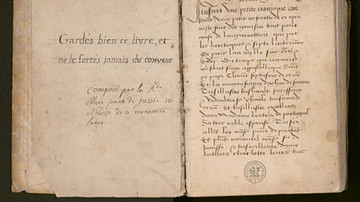
Jeanne de Jussie's Short Chronicle
Jeanne de Jussie's Short Chronicle (1535) is an eyewitness account by the nun Jeanne de Jussie (l. 1503-1561) relating how the Protestant Reformation in Geneva, Switzerland, impacted the lives of the sisters of her convent of Poor Clares...

Article
Ghosts in the Middle Ages
The medieval Church informed the people's religious imagination during the Middle Ages (c. 476-1500) and the world was therefore interpreted - even by heterodox Christians - through the Church's lens. Ghosts – referred to as revenants – were...

Definition
Gunpowder Plot - Guy Fawkes & the Plan to Blow up Parliament
The 1605 Gunpowder Plot was a failed attempt by pro-Catholic conspirators to blow up the English Parliament on 5 November and kill King James I of England (r. 1603-1625) and the entire nobility along with him. The plot was discovered when...

Article
Martin Luther's 95 Theses
Martin Luther's 95 Theses of 31 October 1517, although they have since come to represent the beginning of the Protestant Reformation, were not written to challenge the authority of the Roman Catholic Church but were simply an invitation to...

Article
Christian Antisemitism in the Middle Ages & during the Reformation
Antisemitism is a modern term that describes prejudice and hostility to Jews and Judaism. The origins of Christian antisemitism in the gospels are based on the story of a 1st-century itinerant Jewish preacher, Jesus of Nazareth, in the Roman...

Definition
Augustine of Hippo
Aurelius Augustinus Hipponensis (354-430), better known as Augustine of Hippo, is extolled as the greatest of the Christian Church Fathers. More than any other writer, he developed what would become known as systematic theology, or an explanation...

Article
The Ideology of the Holy Roman Empire
"The Holy Roman Empire was in no way holy, nor Roman, nor an empire," wrote Voltaire, and this interpretation still dominates the popular imagination, so the Holy Roman Empire is treated as a bad joke, a pale parody of the glory of Rome...
