
Search
Did you mean: Ugarit?
Remove Ads
Advertisement
Search Results
Definition
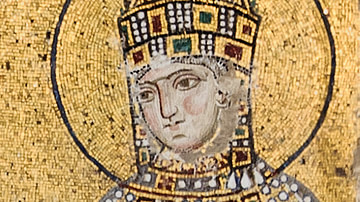
Empress Zoe - The Great Byzantine Ruler
Zoe Porphyrogenita was empress of the Byzantine Empire from 1028 CE until her death in 1050 CE. In an eventful career, she reigned alongside three husbands, had a hand in the succession of her adopted son, and...

Image
The Twelve Major Sieges of Constantinople (626–1453 CE) - War, Survival, and the Fall of the Byzantine Capital
The city of Constantinople, founded as an imperial capital by Constantine I in 330 CE, occupied a commanding position on the Bosporus between Europe and...

Definition
The Battle of Abritus - Historic Gothic Victory Over Rome
The Battle of Abritus was an engagement fought between the armies of Rome under Emperor Decius (reign 249-251) and a coalition of Goths under the leadership of Cniva (circa 250 to circa 270?) in...
Definition
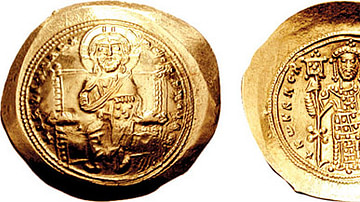
Constantine X Doukas
Constantine X Doukas was the ruler of the Byzantine Empire from 1059 to 1067 CE. During his reign, the Byzantine Empire was attacked by emerging enemies on all sides, including the Normans in Italy and the Seljuk Turks in...
Definition
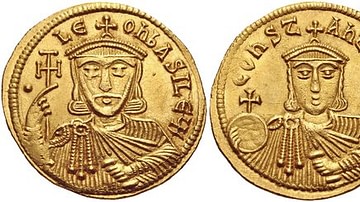
Leo V the Armenian
Leo the V the Armenian was emperor of the Byzantine Empire from 813 to 820 CE. He was of Armenian descent and the last ruler of the Isaurian dynasty which had been founded by Leo III (r. 717-741 CE). The emperor's reign, after...
Image
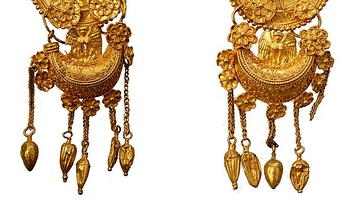
Hellenistic Gold Earrings
A pair of Hellenistic gold earrings, 4th century BCE. Found in tomb II of Mogilanska Mogila tumulus at Vratsa. (Regional Historical Museum, Vratsa, Bulgaria)
Photography: Regional Historical Museum, Vratsa, Bulgaria.

Article
The Pre-WWI Alliance System - Triple Entente v. Triple Alliance
The alliance system in Europe was one of the causes of the First World War (1914-18), although it did not make war inevitable. In the first decade of the 20th century, the Triple Entente powers...

Article
Trade in the Byzantine Empire
Trade and commerce were essential components of the success and expansion of the Byzantine Empire. Trade was carried out by ship over vast distances, although for safety, most sailing vessels were restricted to the...

Article
How Germany Lost World War I
Germany started the First World War (1914-18) with the belief its armed forces could win a quick and decisive victory over France and then Russia. The reality turned out to be much more complicated as more countries...

Article
The 1918 Armistice with Germany - Allied Victory on WWI's Western Front
The armistice that ended the First World War (1914-18) on the Western Front was signed between Germany and the Allies on 11 November 1918. The guns fell silent at 11:00 a.m. that day...
