
Search
Remove Ads
Advertisement
Search Results

Definition
Francois Tomb - Etruscan Tomb at Vulci
The Francois Tomb is an Etruscan tomb located at Vulci (Velch to the Etruscans), a town located 12 km from the western coast of central Italy, by the banks of the Fiora River. Flourishing as a trading port between...
Definition
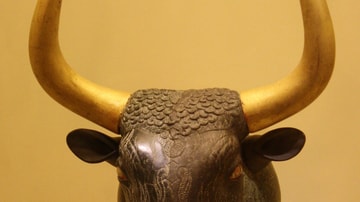
Ancient Crete
Crete is an island in the eastern Mediterranean which during the Bronze Age produced the influential Minoan civilization with its distinctive architecture and art. An important member of the Greek world in the Archaic period, Crete...

Definition
Tophet
The tophet (also topheth) was a sacred precinct usually located outside cities where sacrifices and burials were made, especially of young children, in rituals of the Phoenician and then Carthaginian religion. The tophet is the most evident...

Definition
Narcissus
Narcissus is a figure from Greek mythology who was so impossibly handsome that he fell in love with his own image reflected in a pool of water. Even the lovely nymph Echo could not tempt him from his self-absorption. Narcissus' name...

Definition
Tigranes the Great
Tigranes II or Tigranes the Great ruled as the king of Armenia from c. 95 to c. 56 BCE. Expanding in all directions, at its peak, Tigranes' Armenian Empire stretched from the Black Sea to the Mediterranean. Not before or since...

Definition
Prince Shotoku
Prince Shotoku (574-622 CE) ruled as regent of Japan from 594 to 622 CE and is one of the most celebrated figures in all of Japanese history. The prince was a great supporter of Chinese culture and Buddhism, spreading both during...

Definition
Vercingetorix
Vercingetorix (82-46 BCE) was a Gallic chieftain who rallied the tribes of Gaul (modern-day France) to repel the Roman invasion of Julius Caesar in 52 BCE. His name means "Victor of a Hundred Battles" and was not his birth name...

Definition
Ehecatl
Ehecatl was a Mesoamerican god of air and winds, especially those which brought rains. Regarded as a manifestation of the great feathered serpent god Quetzalcoatl, he was sometimes known as Quetzalcoatl-Ehecatl, in which guise he helped...

Definition
Cimon
Cimon (c. 510 – 450 BCE) was an Athenian statesman and, as strategos, frequent commander of the Athenian fleet when the city was at the height of its power. He won military glory by defeating Spartan rival Pausanias and then the Persians...

Definition
Kamakura Period
The Kamakura Period or Kamakura Jidai (1185-1333 CE) of medieval Japan began when Minamoto no Yoritomo (1147-1199 CE) defeated the Taira clan at the Battle of Dannoura in 1185 CE. The period is named after Kamakura, a coastal...
