
Search
Did you mean: Athena?
Remove Ads
Advertisement
Search Results

Article
The Temple of Hatshepsut
Among the duties of any Egyptian monarch was the construction of monumental building projects to honor the gods and preserve the memory of their reigns for eternity. These building projects were not just some grandiose...

Article
A Brief History of Egyptian Art
Art is an essential aspect of any civilization. Once the basic human needs have been taken care of such as food, shelter, some form of community law, and a religious belief, cultures begin producing artwork, and often...

Article
Monotheism in the Ancient World
Monotheism is simply defined as the belief in one god and is usually positioned as the polar opposite of polytheism, the belief in many gods. However, the word monotheism is a relatively modern one that was coined...

Article
Great Female Rulers of Ancient Egypt
Women in ancient Egypt had more rights than in any other ancient culture and were valued with greater respect. This is evident not only in the physical evidence and inscriptions but in their religion. Some of the...

Article
Gods & Goddesses of Ancient Egypt - A Brief History
The land of ancient Egypt was alive with the spirit of the gods. The sun god Ra broke from the darkness every morning in his great boat, bringing the light, and many of the gods watched over the people...

Article
Conflict Between the Temple and the Crown in Ancient Egypt
The gods of ancient Egypt were worshipped as the creators and sustainers of all life. People acknowledged their supremacy and intimacy daily through rituals, amulets, and their labor for the king...
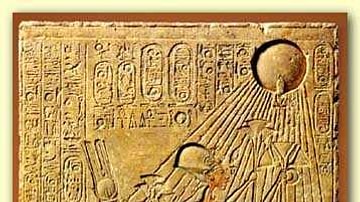
Image
Akhenaten Stele
A stele depicting Egyptian pharaoh Akhenaten (r. 1353-1336 BCE) and his family worshipping the Aten or sun disk.

Image
Akhenaten & Nefertiti at a Feast
The royal couple, pharaoh Akhenaten (r. 1353-1336 BCE) and queen Nefertiti (c. 1370 - c. 1336 BCE), is seated at a feast, beneath the god Aten and under his rays. They are looking at each other and Nefertiti puts...

Image
Statue of Akhenaten
This fragmentary statue of the pharaoh Akhenaten (Amenhotep IV) dates from the Amarna Period (c. 1353-1336 BCE), and was originally housed in a temple complex to the Aten near Karnak, in what is now modern-day Luxor. Currently...
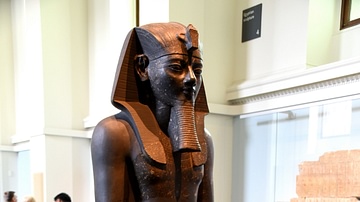
Image
King Amenhotep III
The enthroned pharaoh has idealized features and wears a striped head-cloth, false beard, and pleated kilt. A bull's tail, symbol of superhuman strength, hangs between the legs. Many Egyptian kings used the title of "bull" or...
