
Search
Did you mean: Athena?
Remove Ads
Advertisement
Search Results
Image
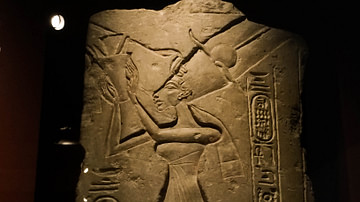
Nefertiti Offering to the Aten
This Amarna Period limestone relief (ca. 1353-1336 BCE) depicts Queen Nefertiti offering a bouquet to the Aten. It is a prime example of the typical Amarna style, as it depicts the queen with an elongated face, slanted...

Image
Smaller Aten Temple, Amarna
The Small Aten Temple, built during the reign of Akhenaten (1353-1336 BCE), is still visible today due to reconstruction efforts following the in situ ancient gypsum building plan. Amarna, Egypt. Photo by Kyera Giannini...

Definition
Amun
Amun (also Amon, Ammon, Amen, Amun-Ra) is the ancient Egyptian god of the sun and air. He is one of the most important gods of ancient Egypt who rose to prominence at Thebes at the beginning of the period of the New Kingdom (c. 1570-1069...

Definition
Tutankhamun
Tutankhamun (also known as Tutankhamen and `King Tut', r. c.1336-c.1327 BCE) is the most famous and instantly recognizable Pharaoh in the modern world. His golden sarcophagus is now a symbol almost synonymous with Egypt. His name...

Interview
Interview: Egyptian Mythology by Garry Shaw
World History Encyclopedia is joined by Egyptologist and author Garry Shaw to chat about his new book Egyptian Mythology: A Traveller's Guide from Aswan to Alexandria. Kelly (WHE): Do you want to start with...

Definition
New Kingdom of Egypt - The Age of Empire
The New Kingdom (circa 1570 to circa 1069 BCE) is the era in Egyptian history following the disunity of the Second Intermediate Period (circa 1782-1570 BCE) and preceding the dissolution of the central government...
Definition
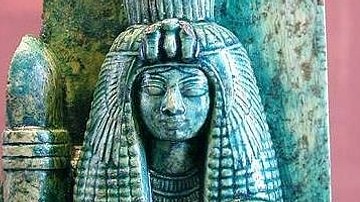
Tiye
Tiye (also known as Tiy, 1398-1338 BCE) was a queen of Egypt of the 18th dynasty, wife of the pharaoh Amenhotep III, mother of Akhenaten, and grandmother of both Tutankhamun and Ankhsenamun. She exerted an enormous influence at the courts...

Definition
Thebes (Egypt)
Thebes was the capital of Egypt during the period of the New Kingdom (c.1570-c.1069 BCE) and became an important center of worship of the god Amun (also known as Amon or Amen, a combination of the earlier gods Atum and Ra). Its...

Definition
Moses
Moses (c. 1400 BCE) is considered one of the most important religious leaders in world history. He is claimed by the religions of Judaism, Christianity, Islam, and Bahai as an important prophet of God and the founder of monotheistic belief...

Definition
Horemheb
Horemheb (reigned 1320-1292 BCE) was the last pharaoh of the 18th dynasty of Egypt. He is also known as Dejserkheprure and Horemhab. His name means, “Horus is in Festival” and he came from the lower classes of Egypt, worked himself...
