
Search
Remove Ads
Advertisement
Search Results
Article
Religious Developments in Ancient India
For well over 1,000 years, sacred stories and heroic epics have made up the mythology of Hinduism. Nothing in these complex yet colourful legends is fixed and firm. Pulsing with creation, destruction, love...

Video
A Short History of Assyria and the Neo-Assyrian Empire
Assyria has a long history, beginning in northern Mesopotamia and then expanding during the Neo-Assyrian Empire from Mesopotamia through Asia Minor, and down through Egypt. The empire began in the...

Definition
Mesopotamian Warfare - Early Development of Armed Conflict
Ancient Mesopotamian warfare progressed from companies of a city's militia in Sumer to the professional standing armies of Akkad, Babylon, Assyria, and Persia, and from conflicts over land or water...

Article
The Spread of Islam in Ancient Africa
Following the conquest of North Africa by Muslim Arabs in the 7th century CE, Islam spread throughout West Africa via merchants, traders, scholars, and missionaries, that is largely through peaceful means whereby...
Image
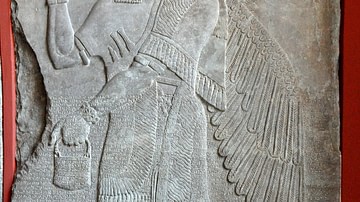
Assyrian Protective Spirit, Nimrud
Alabaster bas-relief, depicting a standing human-headed genie or sage, from the North-West Palace of Ashurnasirpal II at Nimrud, Mesopotamia, modern-day Iraq. Neo-Assyrian Empire, 9th century BCE. Apkallu, a protective...
Image
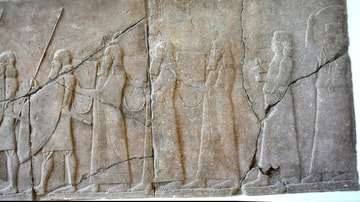
Assyrian Wall Relief Depicting Musical Instruments
Alabaster bas relief depicting marching shield bearers accompanied by a group of musicians who carry different musical instruments, from Nineveh, northern Mesopotamia, Iraq, Neo-Assyrian Empire, reign...

Image
Assyrian War Relief Panel, Nimrud
Alabaster bas-relief showing Assyrian soldiers playing catch with decapitated heads of their enemies. Neo-Assyrian Period, 865-860 BCE. Detail of Panel 6 (top), Room B, the North-Palace Palace, Nimrud, modern-day...
Image
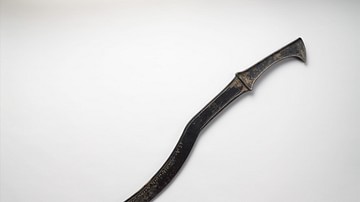
Assyrian Sickle Sword
A bronze Assyrian sickle sword that is believed to have belonged to the Assyrian king Adad Nirari I (r. 1307-1275 BCE), made in northern Mesopotamia, c. 13th century BCE. The blade bears the cuneiform inscription: "Palace...
Image
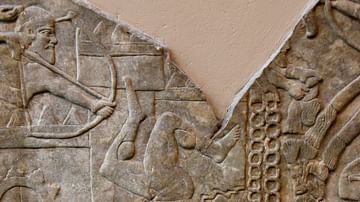
Assyrian Soldiers Attacking a City
Alabaster bas-relief depicting an overwhelming Assyrian attack on a city. Neo-Assyrian Period, 865-860 BCE. Detail of Panel 5 (bottom), Room B, the North-Palace Palace, Nimrud, modern-day Iraq. (The British Museum...
Image
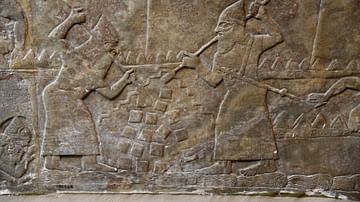
Assyrian Soldiers with Iron Crowbars
Alabaster bas-relief depicting Assyrian soldiers using iron crowbars. Neo-Assyrian Period, 865-860 BCE. Detail of Panel 4 (bottom), Room B, the North-Palace Palace, Nimrud, modern-day Iraq. (The British Museum...
