
Search
Remove Ads
Advertisement
Search Results

Definition
Ancient Persian Government
The government of ancient Persia was based on an efficient bureaucracy which combined the centralization of power with the decentralization of administration. The Achaemenid Empire (c. 550-330 BCE) founded by Cyrus the...
Article
Religious Developments in Ancient India
For well over 1,000 years, sacred stories and heroic epics have made up the mythology of Hinduism. Nothing in these complex yet colourful legends is fixed and firm. Pulsing with creation, destruction, love...

Image
Map of the Assyria in the Middle Assyrian Period - Campaigns and Rival Powers in the Late Bronze Age
The Middle Assyrian period (c. 1365–1000 BCE) emerged from the shifting balance of power in the Late Bronze Age Near East. After earlier subordination to Mitanni...

Image
Map of the Rise and Expansion of the Neo-Assyrian Empire - Conquest and Imperial Power Across the Near East
The Neo-Assyrian Empire emerged from renewed Assyrian state-building in northern Mesopotamia during the early first millennium BCE. Under Adad-nirari II (reign...

Image
High-Ranking Assyrian Officials
An almost 3-meter-high alabaster bas-relief depicting four high-ranking Assyrian officials or dignitaries, stepping forward to greet the Assyrian king, Sargon II. From the Royal Palace of Sargon II at Khorsabad, in...
Image
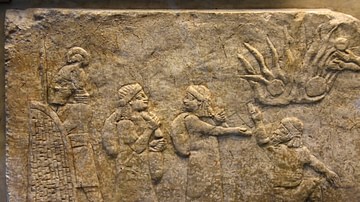
Assyrian Relief Showing Babylonian Prisoners
Assyrian alabaster panel showing Babylonian prisoners in a camp, from the North Palace at Nineveh, Northern Mesopotamia, modern-day Iraq, Neo-Assyrian Empire, reign of Ashurbanipal II, 668-630 BCE. To the...

Image
Assyrian Deportation of People
Assyrian relief, from the Central Palace at Nimrud (ancient Kalhu), Mesopotamia, Iraq. This is one of a series of panels that showed Tiglath-Pileser III's military campaigns in modern-day southern Iraq. On the left...
Image
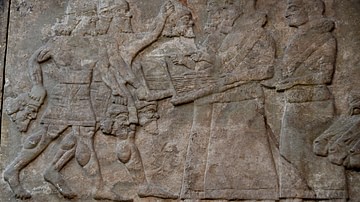
Decapitated Heads of Assyrian Enemies
Alabaster bas-relief showing Assyrian soldiers holding the decapitated heads of their defeated enemy before Assyrian musicians. Neo-Assyrian Period, 865-860 BCE. Detail of Panel 6 (top), Room B, the North-Palace...
Image
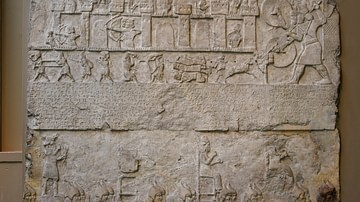
Assyrian Military Campaign Against Syria
Assyrian wall panel from the Central Palace at Nimrud (ancient Kalhu), Mesopotamia, Iraq, reused later in the South-West Palace, from the reign of Tiglath-Pileser III, c. 728 BCE. The panel, one of a series...

Image
Decapitated Soldier, Assyrian Relief
Alabaster bas-relief sowing a beheaded soldier; he was an Assyrian enemy. An Assyrian cavalry is passing over him. Neo-Assyrian Period, 865-860 BCE. Detail of Panel 9 (top), Room B, the North-Palace Palace, Nimrud...
