
Search
Did you mean: Ashurnasirpal II?
Remove Ads
Advertisement
Search Results
Image
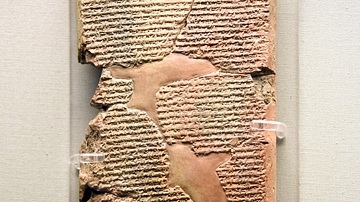
Clay Tablet Naming Gyges of Lydia
This clay tablet is inscribed in a cuneiform script. It is an account of the Egyptian campaigns of Ashurbanipal II, king of Assyria (reigned 668-627 BCE) and his reception of an embassy from Gyges, the first king of Lydia. From the library...
Image
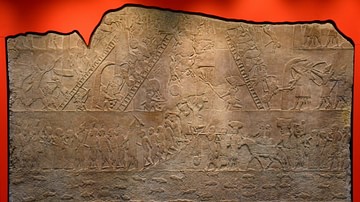
Assyrian Army Attacking Memphis
Gypsum panel showing the Assyrian army attacking the Egyptian city of Memphis and commemorating the final victory of the Assyrian king Ashurbanipal II over the Egyptian king Taharqa in 667 BCE. Panel 17, Room M of the North Palace at Nineveh...
Image
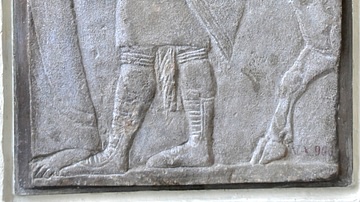
Capture of the Elamite city of Din-Sharri
This alabaster bas relief was part of a large wall relief that depicts the military campaign of Ashurbanipal against the Elamite city of Din-sharri. The relief shows an Assyrian soldier leading a captured woman and a cow away, as part of...
Image
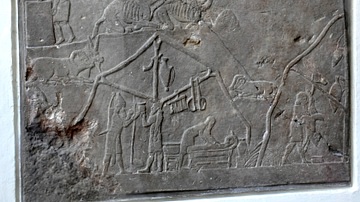
Siege of the Elamite city of Hamanu
This small alabaster bas relief was part of a larger relief that documented the military campaign of the Assyrian king Ashurbanipal against the Elamite city of Hamanu. The Assyrian camp was built before Hamanu's city walls. There are two...

Article
12 Great Cities of Ancient Mesopotamia - The Rise and Fall of the Earliest Cities in the World
The great cities of Mesopotamia ("the land between two rivers") developed prior to the late 4th millennium BCE along two rivers – the Tigris and Euphrates – and were fully established by the Early Dynastic period (circa 2900 to circa 2350/2334...

Article
The World's Oldest Love Poem - The Love Song for Shu-Sin
The world's oldest love poem is The Love Song for Shu-Sin (written circa 2000 BCE), composed in ancient Mesopotamia for use in part of the sacred rites of fertility. Prior to its discovery in the 19th century and its translation in the 20th...

Article
The Eternal Life of Gilgamesh
The Epic of Gilgamesh is among the most popular works of literature in the present day and has influenced countless numbers of readers but, for the greater part of its history, it was lost. The Assyrian Empire fell to a coalition of Babylonians...

Article
The Nimrud Dogs
The Nimrud Dogs, five canine figurines found at the ancient Mesopotamian city of Nimrud, were only a few of the many startling finds in the region during the 19th century when expeditions were sent to corroborate biblical narratives through...

Video
A Short History of Assyria and the Neo-Assyrian Empire
Assyria has a long history, beginning in northern Mesopotamia and then expanding during the Neo-Assyrian Empire from Mesopotamia through Asia Minor, and down through Egypt. The empire began in the city of Ashur and went through many different...
Image
Flood Tablet of the Epic of Gilgamesh
This is the 11th tablet of the Epic of Gilgamesh. The cuneiform text on this tablet is startlingly similar to the Biblical story of Noah and his ark in the Book of Genesis. When George Smith, an assistant in the British Museum first read...
