
Search
Did you mean: Ashurnasirpal II?
Remove Ads
Advertisement
Search Results

Article
The Myth of Etana
The Myth of Etana is the story of the Sumerian antediluvian King of Kish who ascends to heaven on an eagle to request the Plant of Birth from the gods so that he might have a son. Etana is named as the first king of Kish in the Sumerian King...

Image Gallery
A Gallery of Assyrian Warfare
The Assyrian military was the most effective – and feared – fighting force in the Near East, especially during the time of the Neo-Assyrian Empire, 912-612 BCE, when their territory expanded across Mesopotamia, the Levant, into Asia Minor...

Definition
The Kingdom of Kush
Kush was a kingdom in northern Africa in the region corresponding to modern-day Sudan. The larger region around Kush (later referred to as Nubia) was inhabited c. 8,000 BCE but the Kingdom of Kush rose much later. The Kerma Culture, so named...

Definition
Mesopotamian Government - Helping and Serving the Gods
Ancient Mesopotamian government was based on the understanding that human beings were created to help and serve the gods. The high priest, king, assembly of elders, governors, and any other officials were recognized as stewards chosen by...

Definition
Ninurta
Ninurta (identified with Ningirsu, Pabilsag, and the biblical Nimrod) is the Sumerian and Akkadian hero-god of war, hunting, and the south wind. He first appears in texts in the early 3rd millennium BCE as an agricultural god and local deity...

Definition
Memphis (Ancient Egypt)
Memphis was one of the oldest and most important cities in ancient Egypt, located at the entrance to the Nile River Valley near the Giza plateau. It served as the capital of ancient Egypt and an important religious cult center. The original...

Definition
Kalhu / Nimrud
Kalhu (also known as Caleh, Calah, and Nimrud, in modern-day northern Iraq) was a city in ancient Mesopotamia that became the capital of the Assyrian Empire under Ashurnasirpal II (r. 884-859 BCE) who moved the central government there from...

Image
Assyrian Lion Hunt Relief
Frieze depicting a lion hunt, from the royal palace of Ashurbanipal, Nineveh, modern-day Iraq. Neo-Assyrian Empire, 668-631 BCE. The king's role was to protect his people from enemies. In ancient Assyria, this was symbolized in the lion...
Image
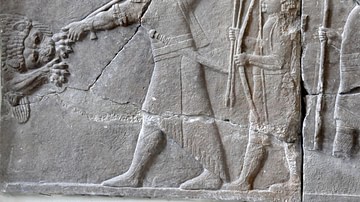
Assyrian Lion Hunt Relief, Nineveh
Gypsum wall relief depicting the typical royal hunting of lions, part of a longer sequence. The king, Ashurbanipal II, thrusts a spear onto a leaping and furious lion. Behind him, an Elamite squire assists him. Partially appearing on the...
Image
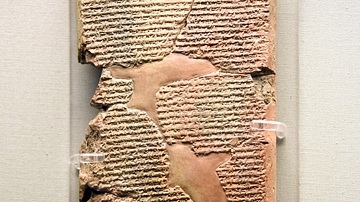
Clay Tablet Naming Gyges of Lydia
This clay tablet is inscribed in a cuneiform script. It is an account of the Egyptian campaigns of Ashurbanipal II, king of Assyria (reigned 668-627 BCE) and his reception of an embassy from Gyges, the first king of Lydia. From the library...
