
Search
Did you mean: Ashurnasirpal II?
Remove Ads
Advertisement
Search Results

Definition
Literature - The Artistic Expression of the Human Experience
Literature (from the Latin Littera meaning "letters" and referring to an acquaintance with the written word) is the written work of a specific culture, sub-culture, religion, philosophy, or the study of such written work which may appear...

Definition
Ancient Syria
Syria is a country located in the Middle East on the shore of the Mediterranean Sea and bordered, from the north down to the west, by Turkey, Iraq, Jordan, Israel, and Lebanon. It is one of the oldest inhabited regions in the world with archaeological...

Definition
Shulgi of Ur - Greatest King of the Ur III Period
Shulgi of Ur (reign 2094 to circa 2046 BCE) is considered the greatest king of the Ur III period in Mesopotamia (circa 2112 to circa 2004 BCE). His father was Ur-Nammu (reign circa 2112-2094 BCE), who founded the Third Dynasty of Ur, and...

Definition
Thebes (Egypt)
Thebes was the capital of Egypt during the period of the New Kingdom (c.1570-c.1069 BCE) and became an important center of worship of the god Amun (also known as Amon or Amen, a combination of the earlier gods Atum and Ra). Its sacred name...

Definition
Karnak
Karnak is the modern-day name for the ancient site of the Temple of Amun at Thebes, Egypt. The Egyptians called the site Nesut-Towi, "Throne of the Two Lands", Ipet-Iset, "The Finest of Seats" as well as Ipt-Swt, "Selected Spot" also given...

Definition
Arabia
The ancient Arabians, or Arabes as they were called by the Hellenes, were a Semitic people. One must note that the Arabians were not a single people but multiple smaller kingdoms and tribes. Arabia was home to great city builders and nomads...

Definition
Gula
Gula (also known as Ninkarrak) is the Sumerian goddess of healing and patroness of doctors, healing arts, and medical practices. She is first attested to in the Ur III Period (2047-1750 BCE) where she is referenced as a great goddess of health...

Definition
Dur-Sharrukin
Dur-Sharrukin (modern Khorsabad, Iraq) was a city built by Sargon II of Assyria (r. 722-705 BCE) as his new capital between 717-706 BCE. The name means Fortress of Sargon and the building project became the king's near obsession as soon as...
Image
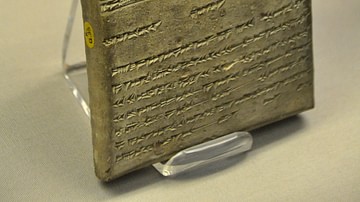
Sumerian Hymn to Ishtar
This hymn to the goddess Ishtar is written in Sumerian; after every line in Sumerian, the text is translated in Akkadian. Such translations have been invaluable to modern scholars. They reflect how the Sumerian language had become difficult...
Image
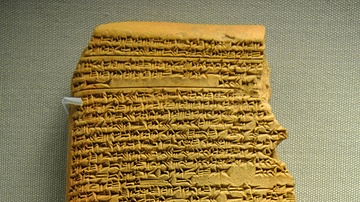
The Theory of Omens
On this clay tablet, the author has listed the titles of cuneiform omen collections drawn from celestial and terrestrial phenomena. Rather unusually, he explains that the validity of an individual omen depends on the particular month and...
