
Search
Did you mean: Amphora?
Remove Ads
Advertisement
Search Results

Article
Ancient Egyptian Agriculture
Agriculture was the foundation of the ancient Egyptian economy and vital to the lives of the people of the land. Agricultural practices began in the Delta Region of northern Egypt and the fertile basin known as the Faiyum...

Article
Trade in Ancient Egypt
Trade has always been a vital aspect of any civilization whether at the local or international level. However many goods one has, whether as an individual, a community, or a country, there will always be something one lacks...
Image
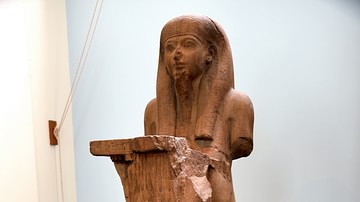
Statue of the Nile God Hapy
Statue of the Nile God Hapy, from Thebes, Karnak, temple of Amun-Ra, Egypt, 22nd Dynasty, reign of Osorkon I, c. 924-889 BCE. The fleshy body symbolizes the Nile's fertility. Hapy holds a table of offerings, from which...
Image
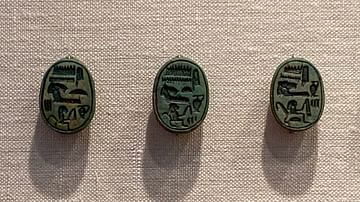
Scarabs of Hatshepsut
Scarabs of Hatshepsut (r. 1479-1458 BCE), 18th Dynasty, New Kingdom of Egypt. Metropolitan Museum of Art, New York. The Metropolitan Museum of Art was an integral part of the excavations of Hatshepsut's temple at Deir al-Bahri...

Video
Ancient Egyptian Religion: How were the Ancient Egyptian Gods and Goddesses Worshipped?
Ancient Egyptian Religion incorporated so many different aspects; mythology, spiritualism, science, magic, medicine psychology and herbology. With so many different facets...

Video
The Battle of Kadesh: Ancient Egypt vs. The Hittites
The Battle of Kadesh was waged between Ancient Egypt under the rule of Ramesses II (also known as Ramesses the Great), and the Hittite Empire under King Muwatalli II. According to Egyptian chronology...

Image
Statue of Iahmes
Grabbo seated figure of Iahmes, chief of the granaries of the god Amun. From El-Kab, modern-day Egypt. New Kingdom, 18th Dynasty, 1480 BCE. (State Museum of Egyptian Art, Munich, Germany).

Image
Stela of Sobeknakht, Abydos
Limestone stela of Sobeknakht, the overseer of Amun's temple. The stela shows an offering scene and a formula. From Abydos, modern-day Egypt. New Kingdom, 18th Dynasty, circa 1380 BCE. (State Museum of Egyptian Art, Munich...

Image
Stela of Neskhons Queen of Pinezem II
This painted wooden stela depicts a woman whose name was identified as Neskhons; she was the wife of the High Priest of Amun Pinedjem (II). On the right side, Neskhons looks to the left and makes an offerring...

Image Gallery
A Gallery of Tutankhamun & Family
Tutankhamun is easily the most famous Egyptian ruler in the world thanks to his nearly intact tomb discovered by Howard Carter in 1922 and the "mummy's curse" associated with the opening of that tomb. Although Tutankhamun...
