
Search
Did you mean: Amphora?
Remove Ads
Advertisement
Search Results

Definition
Ammon (Deity)
Ammon is the name of a Libyan deity and his oracle in the desert. It became famous after Alexander the Great made a detour to consult the god. The modern name is Siwa. Oracle at Siwa Ammon was a Libyan deity, whose oracle was...

Definition
Ancient Egyptian Culture
Ancient Egyptian culture flourished between c. 6000 BCE with the rise of technology (as evidenced in the glasswork of faience) and 30 BCE with the death of Cleopatra VII, the last Ptolemaic ruler of Egypt. It is famous...

Image
Queen Karomama I
Bronze statue of Queen Karomama I, "Divine Worshipper of Amun", wife of Osorkon II of the 22nd Dynasty of Egypt. The statue was made c. 850 BCE and is made of bronze covered with gold, silver, and electrum. It is dedicated to...

Article
Ancient Egyptian Science & Technology
The great temples and monuments of ancient Egypt continue to fascinate and amaze people in the modern day. The sheer size and scope of structures like the Great Pyramid at Giza or the Temple of Amun at Karnak...
Article
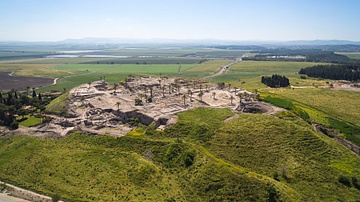
Thutmose III at The Battle of Megiddo
The ancient site of Megiddo was the scene of a number of battles in antiquity and is best known as the source of the word armageddon, the Greek rendering of the Hebrew Har-Megiddo ('Mount of Megiddo') from the...

Article
Ten Ancient Egypt Facts You Need to Know - Fun Trivia About Ancient Egypt
Ancient Egypt is defined as the civilization that flourished in North Africa between circa 6000 and 30 BCE – from the Predynastic Period in Egypt (circa 6000 to circa 3150 BCE) through...

Article
The Gifts of Isis: Women's Status in Ancient Egypt
An inscription on an Egyptian papyrus dating from the 2nd century CE relates that the goddess Isis, bestowing gifts on humanity at the beginning of time, gave as much power and honor to women as she...

Article
Elephants in Hellenistic History & Art
Elephants were thought of as fierce and frightful monsters in antiquity, very real though rarely seen until the Hellenistic period. They were deployed on the battlefield to strike terror into the enemy, however...

Article
Sailing on Lake Nasser towards Abu Simbel
In ancient times, the First Cataract at Aswan marked the southern frontier of Egypt. Beyond lay the land of Nubia, which stretched along the river Nile from the First Cataract southwards for about 250 kilometres...

Article
Gods & Goddesses of Ancient Egypt - A Brief History
The land of ancient Egypt was alive with the spirit of the gods. The sun god Ra broke from the darkness every morning in his great boat, bringing the light, and many of the gods watched over the people...
