
Search
Did you mean: Amphora?
Remove Ads
Advertisement
Search Results

Article
The Temple of Hatshepsut
Among the duties of any Egyptian monarch was the construction of monumental building projects to honor the gods and preserve the memory of their reigns for eternity. These building projects were not just some grandiose...

Definition
Ancient Egyptian Architecture
Ancient Egyptian architecture is often associated closely with the pyramids of Giza but was actually quite diverse, taking a number of forms in the construction of administrative buildings, temples, tombs, palaces...

Definition
Egyptian Empire
The Egyptian Empire rose during the period of the New Kingdom (c. 1570- c. 1069 BCE), when the country reached its height of wealth, international prestige, and military might. The empire stretched from modern-day Syria in the...

Definition
Ramesses II
Ramesses II (r. 1279-1213 BCE, alternative spellings: Ramses, Rameses) was known to the Egyptians as Userma'atre'setepenre, which means 'Keeper of Harmony and Balance, Strong in Right, Elect of Ra'. He is also known also as Ozymandias...

Article
Daily Life in Ancient Egypt
The popular view of life in ancient Egypt is often that it was a death-obsessed culture in which powerful pharaohs forced the people to labor at constructing pyramids and temples and, at an unspecified time, enslaved...

Article
The Art of the Amarna Period
Of all the pharaohs who ruled ancient Egypt, there is one in particular that stands out from the rest. Over the course of his 17-year reign (1353-1336 BCE), Akhenaten spearheaded a cultural, religious, and artistic revolution...
Article
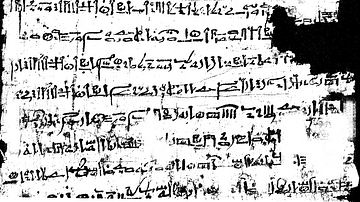
The Report of Wenamun & the Perils of Living in the Past
The Report of Wenamun (also known as The Tale of Wenamun or The Report of Wenamon) is an Egyptian literary work dated to c. 1090-1075 BCE toward the end of the New Kingdom (c.1570 - c. 1069 BCE...

Definition
Meroë
Meroe was a wealthy metropolis of the ancient kingdom of Kush in what is today the Republic of Sudan. It was the later capital of the Kingdom of Kush (c. 1069 BCE to c. 350 CE) after the earlier capital of Napata was sacked c. 590 BCE...

Article
Women's Work in Ancient Egypt
Women in ancient Egypt had greater rights than in any other civilization of the time. They could own land, initiate divorce, own and operate their own business, become scribes, priests, seers, dentists, and doctors...

Definition
Ancient Egyptian Government
The government of ancient Egypt was a theocratic monarchy as the king ruled by a mandate from the gods, initially was seen as an intermediary between human beings and the divine, and was supposed to represent the gods'...
