
Search
Did you mean: Amenhotep III?
Remove Ads
Advertisement
Search Results

Article
Balance & the Law in Ancient Egypt
Egyptian law was based on the central cultural value of ma'at (harmony and balance) which was the foundation for the entire civilization. Ma'at was established at the beginning of time by the gods when the earth...

Article
The Gifts of Isis: Women's Status in Ancient Egypt
An inscription on an Egyptian papyrus dating from the 2nd century CE relates that the goddess Isis, bestowing gifts on humanity at the beginning of time, gave as much power and honor to women as she...

Article
Wonderful Things: Howard Carter's Discovery of Tutankhamun's Tomb
The great discoverer of the treasures of King Tutankhamun, Howard Carter, was born on May 9, 1874 CE to Samuel John and Martha Joyce (Sands) Carter in Kensington, England. A sick, home-schooled...

Video
Egypt: New Kingdom
This video summarises the main events and developments of Egypt's New Kingdom.

Video
Greatest Pharaohs of Egypt
This video depicts the reign of a few of the greatest Egyptian Pharaohs between 1350 and 1070 BCE (during the New Kingdom). It is one video in a series. It also displays examples of monuments and artworks that correspond...

Image Gallery
A Gallery of Tutankhamun & Family
Tutankhamun is easily the most famous Egyptian ruler in the world thanks to his nearly intact tomb discovered by Howard Carter in 1922 and the "mummy's curse" associated with the opening of that tomb. Although Tutankhamun...

Image
Map of Trade Networks of the Late Bronze Age Mediterranean - Empires, Merchants, and Maritime Routes of the Ancient World
The Late Bronze Age eastern Mediterranean (c. 1500–1200 BCE) was marked by an unprecedented level of diplomatic and commercial interdependence...

Image
Vizier Rekhmire Receiving Offerings
A depiction from the tomb of the vizier Rekhmire showing him and his mother receiving offerings. Rekhmire served under the pharaohs Thutmose III (1458-1425 BCE) and his son Amenhotep II (1425-1400 BCE). (Metropolitan...
Image
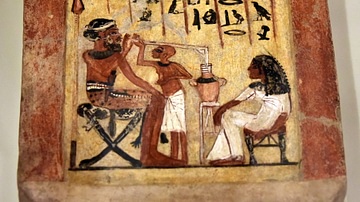
Egyptian Stele of a Syrian Mercenary
A mid 2nd Millennium BCE painted limestone stele showing a Syrian mercenary drinking beer. The mercenary;s name is Terura and his wife's name is Arbura. His facial features and dress clearly identify him as a Syrian...

Image
Statue of Akhenaten
This fragmentary statue of the pharaoh Akhenaten (Amenhotep IV) dates from the Amarna Period (c. 1353-1336 BCE), and was originally housed in a temple complex to the Aten near Karnak, in what is now modern-day Luxor. Currently...
