
Search
Did you mean: Adad Nirari I?
Remove Ads
Advertisement
Search Results

Definition
Eurydice I - The First Macedonian Queen with Political Influence
Eurydice I (circa 410 to before 343 BCE) is the earliest queen in the history of ancient Macedonia, whose impact on the political affairs of her time is known to us. Born to the royal house...

Definition
Nineveh - The Great Cultural Center That Became the "City of Sin"
Nineveh (modern-day Mosul, Iraq) was one of the oldest and greatest cities in antiquity. It was originally known as Ninua, a trade center, and would become one of the largest and most affluent...

Definition
Colossi of Memnon
The Colossi of Memnon (also known as el-Colossat or el-Salamat) are two monumental statues representing Amenhotep III (1386-1353 BCE) of the 18th Dynasty of Egypt. They are located west of the modern city of Luxor and face east...

Image
Two Statues of Shalmaneser III at the Iraq Museum
In the centre of this image is the so-called Kurba'il statue of Shalmaneser III (reigned 858-824 BCE), which was found in Fort Shalmaneser in 1961 CE by the British School of Archaeology in Iraq. The...

Definition
Tiglath Pileser I
Tiglath Pileser I (reigned 1115-1076 BCE), an Assyrian king of the period known as the Middle Empire, revitalized the economy and the military that had been suffering, more or less, since the death of the king Tukulti Ninurta...

Definition
Ancient Syria
Syria is a country located in the Middle East on the shore of the Mediterranean Sea and bordered, from the north down to the west, by Turkey, Iraq, Jordan, Israel, and Lebanon. It is one of the oldest inhabited regions in the world...

Image
Assyrian Door-sill
The cuneiform inscription gives the name and genealogy of Adad-nirari III (reigned 810-783 BCE) and was written in doorways of a palace built during his reign. Assyrian, 9th-8th centuries BCE. From Nimrud (ancient Kalhu, Mesopotamia...

Definition
Tukulti-Ninurta I
Tukulti-Ninurta I (reigned 1244-1208 BCE) was a king of the Assyrian Empire during the period known as the Middle Empire. He was the son of Shalmaneser I (reigned 1274-1245 BCE) who had completed the work of his father, Adad...
Image
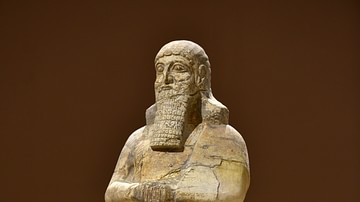
Kurba'il Statue of Shalmaneser III
Kurba'il statue of Shalmaneser III (r. 858-824 BCE), found in Fort Shalmaneser in 1961 by the British School of Archaeology in Iraq. The statue originally stood in the Temple of Adad at the city of Kurba'il...
Image
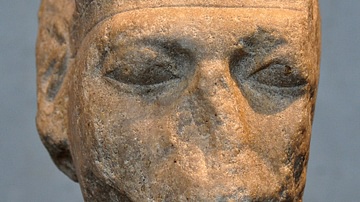
Pharaoh Senusret III
Quartzite head of the Egyptian pharaoh Senusret III (aka Sesostris III) with aged features. Middle Kingdom, 12th Dynasty, 1850 BCE. (State Museum of Egyptian Art, Munich, Germany).
