
Search
Did you mean: Adad Nirari I?
Remove Ads
Advertisement
Search Results

Article
Thutmose III's Battle of Megiddo Inscription
The Battle of Megiddo (c. 1457 BCE) is one of the most famous military engagements in history in which Thutmose III (1458-1425 BCE) of Egypt defeated the coalition of subject regions led in rebellion by...

Image
Stela of Shamshi-Adad V
The limestone Stela of Shamshi-Adad V. Neo-Assyrian, 815-811 BCE. The king is shown giving a gesture of blessing before five divine symbols: Anu's three-horned crown (top), a winged-disk, disk and crescent, fork, and Ishtar's...
Image
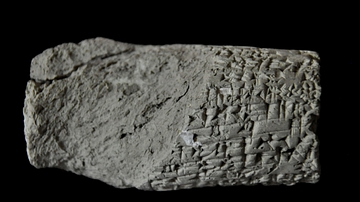
Tablet of King Nur-Adad
This partially broken document mentions the name of King Nur-Adad, king of Larsa, 1921-1905 BCE. (The Sulaimaniya Museum, Iraq).

Definition
George III of Great Britain
George III of Great Britain (r. 1760-1820) was the third of the Hanoverian monarchs, and he remains the longest-reigning king in British history. His six decades on the throne saw the creation of the United Kingdom, the...

Definition
James III of Scotland
James III of Scotland reigned as king from 1460 to 1488. He succeeded his father James II of Scotland (r. 1437-1460) at the age of eight, which led to some nobles taking advantage of the king's minority and even abducting...

Definition
Henry Lee III
Henry Lee III (1756-1818), more commonly known by his nickname 'Light-Horse Harry' Lee, was a cavalry officer in the Continental Army during the American Revolutionary War (1775-1783) and a politician who served as the ninth Governor...

Image
A door socket from Anu-Adad Temple
The cuneiform inscriptions on this door socket mention the name of Shalmaneser III, King of Assyria (858-824 BCE). The king dedicated the stone to the gods Anu and Adad for his life and the well-being of his people...
Image
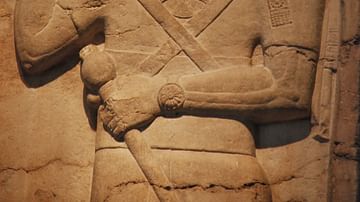
King Shamshi-Adad V
Assyrian stela of Shamshi-Adad V (823-811 BCE) from the temple of Nabu in Nimrud, c. 814 BCE, showing the kind worshipping symbols of the gods. The cross on the king's chest is a symbol of the sun god. Through his dress the...
Image
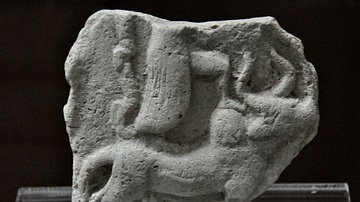
God Adad
In this partially survived terracotta plaque, the god Adad stands on the back of a bull. Adad was the God of weather, hurricanes, storms, thunder, and rain. From Mesopotamia, modern-day Iraq. Old-Babylonian period, 2000-1500 BCE. The...

Definition
Mesopotamian Literature - The Earliest Works of the Imagination
Ancient Mesopotamian literature developed circa 2600 BCE after scribes, who had formerly been record-keepers, began composing original works in the region of Sumer. The Sumerians invented writing...
