
Search
Did you mean: Arretium?
Remove Ads
Advertisement
Search Results

Article
Winged Victory: the Nike of Samothrace
One of the most celebrated works of Hellenistic art is without doubt the Nike of Samothrace, on display at the Louvre since 1884 CE. The white Parian marble statue represents the personification of winged victory...

Article
Hellenistic & Roman Agora of Athens
Pericles’ agora of Athens flourished under Macedonian control. After Macedon was defeated by Rome, the Romans added to the district even before Greece was taken as a province and more so afterwards. The Roman version...

Article
Herod the Great's Building Program
Herod the Great was the king of Judea from 37-4 BCE. As a client king of Rome, Herod's moniker as "Great" was due more to his grand building program throughout the eastern Mediterranean world. Herod's building program...

Article
Parthia: Rome's Ablest Competitor
As a superpower in its own right and in competition with Rome, Parthia's empire - ruling from 247 BCE to 224 CE - stretched between the Mediterranean in the west to India in the east. Not only did the Parthians win...

Article
Rome's Response to the Spread of Christianity
During the 1st century CE, a sect of Jews in Jerusalem claimed that their teacher, Jesus of Nazareth, was the 'messiah' of Israel. 'Messiah' meant 'anointed one', or someone chosen by the God of Israel...

Article
Caesarea Maritima's Role in the Roman Empire
Caesarea Maritima, the city Herod the Great (r. 37-4 BCE) built for Rome on the southeastern coast of the Mediterranean served as the Roman Empire's powerbase of operations both commercially and militarily...

Article
Roman Armor & Weapons
From the days of the hoplites through the creation of the legionary until the fall of the Roman Empire in the west, the Roman army remained a feared opponent, and the Roman legionary's weapons and armor, albeit with minor...
Article
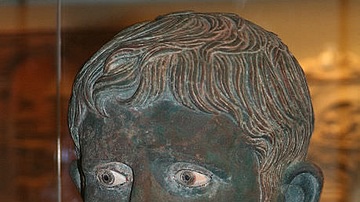
The Meroe Head
The Meroe Head, so-called because it was found beneath a temple in the ruins of Meroe, is the head of a larger-than life statue of Gaius Julius Caesar Augustus (better known as Augustus Caesar) the first Emperor of Rome (reigned...

Article
Exploring Roman Morocco
Morocco, then known as Mauretania, was annexed by the Roman Empire in 40 CE. The Romans in Morocco left a vast legacy with archaeological sites that dot the country's northern landscape, especially Volubilis, with its vestiges...

Article
Pirates of the Mediterranean
The pirates of the ancient Mediterranean were not, for the most part, the outsiders who knew no country's allegiance and were the enemies of civilization as they are frequently depicted in novels and other media. They...
