
Search
Did you mean: Arretium?
Remove Ads
Advertisement
Search Results

Article
Legions of the Parthian Wars
Parthia had always been a thorn in the side of the Roman Empire. The initial campaigns by Crassus and Mark Antony were total failures, and although Trajan and Syrian governor Cassius made some progress in the 2nd century...

Article
The Delian League, Part 3: From the Thirty Years Peace to the Start of the Ten Years War (445/4–431/0 BCE)
This text is part of an article series on the Delian League. The third phase of the Delian League begins with the Thirty Years Peace between Athens and Sparta...
Article
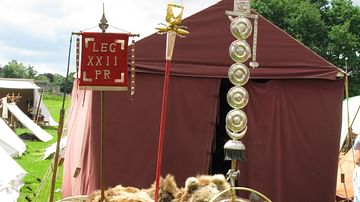
Legions of the Rhine Frontier
After Julius Caesar’s (100-44 BCE) conquest of Gaul, Roman legions pushed the borders of the Roman Empire’s frontier to the banks of the Rhine River. Augustus (r. 27 BCE - 14 CE) divided the newly acquired region into...

Article
Rome's Egyptian Heritage
The Eternal City of Rome is one of the places in the world with the most historical sites to visit. The list of ancient ruins, museums, churches, and other historical landmarks makes the city an Eldorado for anyone interested...

Article
Mark Antony's Parthian Campaign
In 36 BCE, Mark Antony (83-30 BCE) invaded Parthia, hoping to render himself one of the great conquerors of the Greco-Roman world, but he was stymied by Parthian forces and obliged to undertake an arduous, costly retreat...
Article
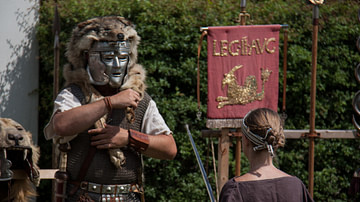
Legions of Britain
After the Roman emperor Claudius (r. 41-54 CE) successfully conquered Britain in 43 CE, four legions were left there to maintain the peace: XIV Gemina, II Augusta, IX Hispana, and XX Valeria Victrix. However, by the end of the...

Article
Hellenistic & Roman Agora of Athens
Pericles’ agora of Athens flourished under Macedonian control. After Macedon was defeated by Rome, the Romans added to the district even before Greece was taken as a province and more so afterwards. The Roman version...

Article
Caesarea Maritima's Role in the Roman Empire
Caesarea Maritima, the city Herod the Great (r. 37-4 BCE) built for Rome on the southeastern coast of the Mediterranean served as the Roman Empire's powerbase of operations both commercially and militarily...

Article
Parthia: Rome's Ablest Competitor
As a superpower in its own right and in competition with Rome, Parthia's empire - ruling from 247 BCE to 224 CE - stretched between the Mediterranean in the west to India in the east. Not only did the Parthians win...

Article
Legions of Spain, Roman Africa & Egypt
The legions of Spain, Roman Africa, and Egypt did not see the intensity of action that prevailed elsewhere in Europe. However, the presence of these four legions - VII Gemina, IX Hispana, XXII Deiotariana, and...
