
Search
Remove Ads
Advertisement
Search Results
Image
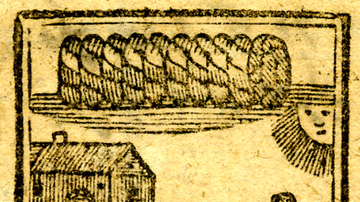
18th-Century Advertisement for Virginia Tobacco
An 18th-century woodcut advertisement for Virginia tobacco. The image shows child slaves working on a tobacco plantation. (British Museum, London)

Image
China Warlords, 2nd-3rd century CE.
A map showing the territories of the main Chinese warlords at the fall of the Han dynasty in the early 3rd century CE.
Image
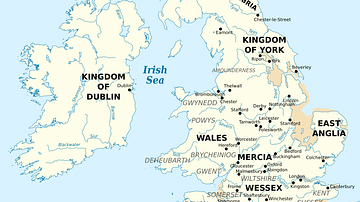
British Isles at the Beginning of the 10th Century
British Isles in 10th century represented with the coastline at the time.

Image
16th century CE Desk with Lute, Globe and Books
A detail of a mid-16th century CE painting by Hans Holbein the Younger showing a desk with a lute, globe and books. From 'The Ambassadors', c. 1533 CE. (National Gallery, London)

Image
East Roman Empire, 6th century CE
East Roman Empire, 6th century CE, showing the territories of the Avars, Goths, Franks, Lombards, Saxons, Thuringians, Slavs.

Image
Detail of a 6th-century Elephant Mosaic
Detail of a 6th-century mosaic floor that used to decorate the pavement of the peristyle court of the Palatium Magnum, the Great Palace of Constantinople. The Great Palace Mosaic Museum houses mosaics from the...

Image
5th Century BCE Demareteion Coin
An illustration of the so-called Demaretéion is a silver coin of ancient Syracuse (weighing around 43 g) rather rare and worth 10 drachmas. It is also known as a pentekontalitron because it was equivalent to 50 litrae...

Image
Rank Badge with Qilin (16th–Early 17th Century)
Rank badge with qilin, silk embroidery on silk gauze, unknown artist, 16th to early 17th century. This embroidered rank badge is from the Ming Dynasty (1368-1644) and was used to indicate military rank...
Image
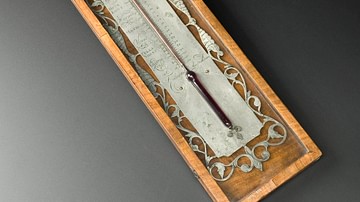
18th-Century Alcohol Thermometer
An 18th-century alcohol thermometer. Made in the Netherlands between 1720 and 1750. (Science Museum, London)
Image
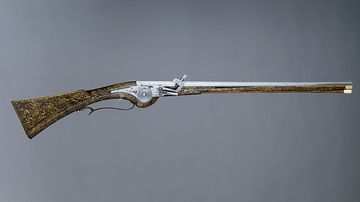
17th-Century Wheellock Carbine
A French 17th-century wheellock carbine. This type of weapon was typically used by cavalrymen, for example, during the English Civil Wars. (1642-51). This example is particularly ornate since it was possibly made for...
