
Search
Remove Ads
Advertisement
Search Results

Image
20th-Century Sepoy
An early-20th-century painting by Major A.C. Lovett of a sepoy in the British Indian Army. (From The Armies of India, 1911)
Image
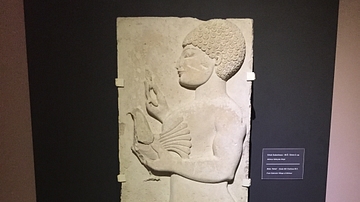
Lydian Relief: 5th Century BCE
This relief of a male holding a bird is from the 5th century BCE, found in modern day western Turkey near the ancient city of Thyatira. Thyatira was named such by Seleucos I Nicator around 290 BCE but prior to that...

Image
Costa Rica, 16th century CE
Map of Costa Rica in the 16th century CE.

Image
19th-Century Christmas Card
A late-19th century Christmas card showing a robin and snow scene. The border is perforated to resemble lace. (Victoria and Albert Museum, London) Orignal source note on usage: 'V&A Owned Content' in which the V&A owns...
Image
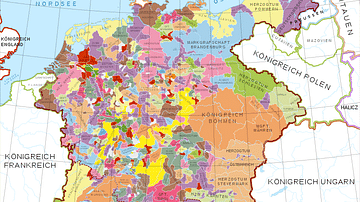
Holy Roman Empire in the 13th century CE
A map in German of central Europe during the time of the Hohenstaufen Emperors, primarily showing the territories of the Holy Roman Empire and the Kingdom of Sicily. The map is a vectorised version of this...
Image
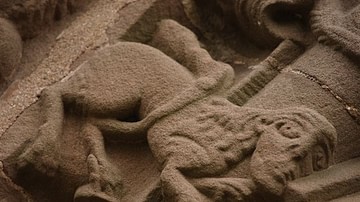
Manticore at the Church of St Mary and St David, Kilpeck, Herefordshire (12th century)
Kilpeck church stone carvings: Manticore. Dating to the 12th century and found at the Church of St Mary and St David in Herefordshire, England.

Image
Monte Cassino in the 15th Century
Illustration of Monte Cassino in the 15th-century Nuremberg Chronicle. Published in Nuremberg, Germany, 1493.
Image
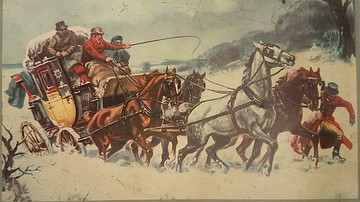
19th-Century Coach Caught in Snow
A picture of a 19th-century coach caught in the snow. From a tin produced by Excelvit. (Private Collection)

Image
Hydria (4th century BCE)
The hydria, as its name indicates, was used almost exclusively for carrying water (Greek hydor), essential for everyday cleansing, ritual purifications and libations. 4th-century BCE. Made from bronze. (Hellenic Museum...

Image
Map of Japan in the 16th Century CE
A map of Japan during the Azuchi-Momoyama period (1568-1600 CE).
