This map collection explores the geopolitical transformation of Europe between 1914 and 1949. From the First World War (1914-18) and the collapse of empires to the rise of fascism, communism, and totalitarian regimes, through the Second Wolrd War (1939-45) and postwar reconstruction, these maps reveal how war and ideology reshaped European borders and power structures, laying the foundation for modern Europe as we know it today.
17th Anniversary Fundraiser
Celebrate our 17th anniversary with an anniversary gift to support free history education around the world!
$2104 / $5000

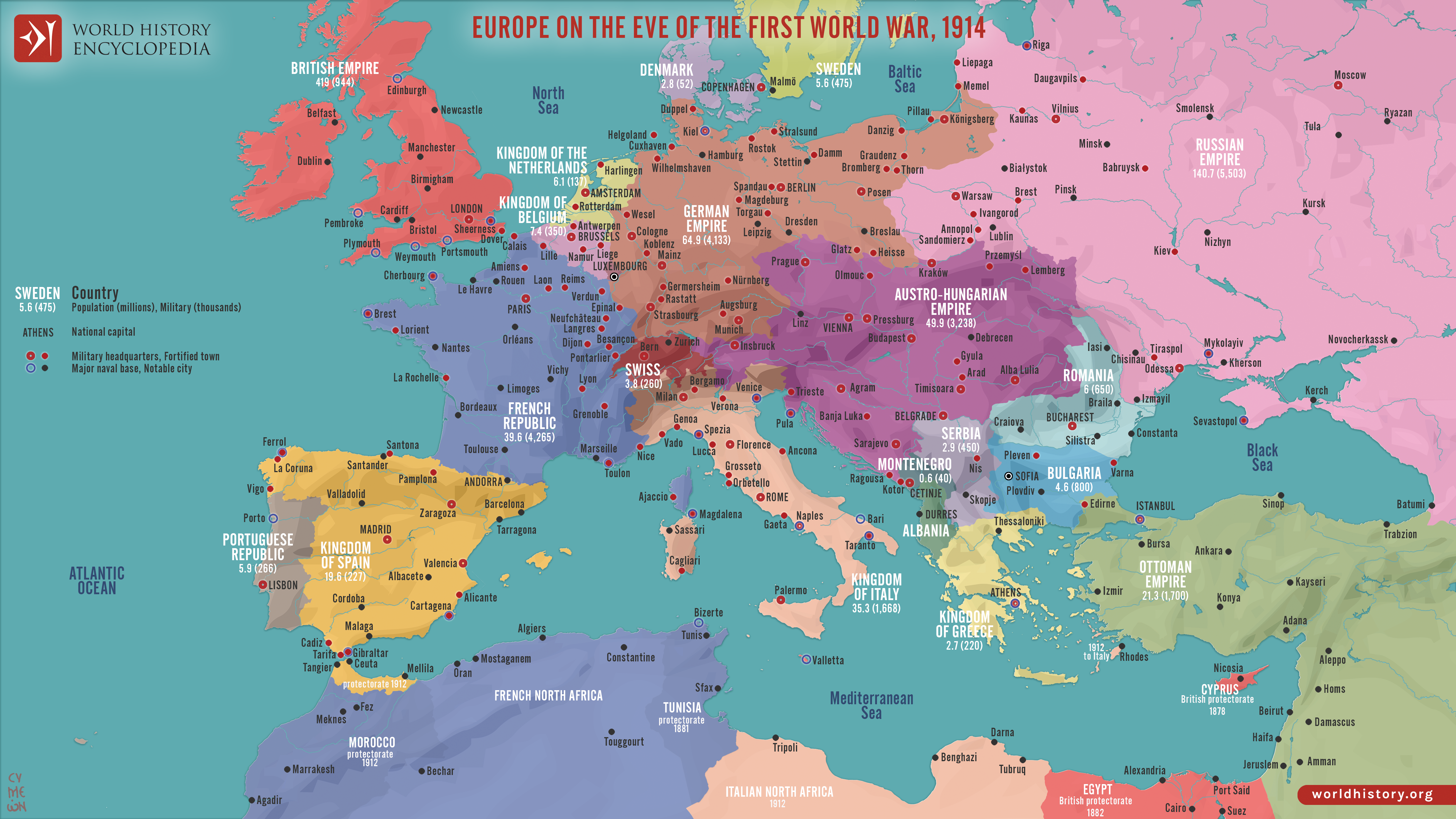
Map of Europe on the Eve of World War I, June 1914

Between German unification (1871) and the outbreak of the First World War (1914), European international relations were increasingly shaped by alliance diplomacy, imperial competition, nationalist claims, and changing calculations of the balance of power. The Triple Alliance joined Germany, Austria-Hungary, and Italy through formal defensive treaties, while the Triple Entente was a looser alignment built around the Franco-Russian Alliance and Britain’s separate agreements with France and Russia. These arrangements did not create automatic wartime blocs, but they encouraged governments to interpret regional crises through fears of encirclement, declining credibility, and strategic isolation. Imperial and naval competition deepened mistrust, while nationalist movements, especially in the Balkans and within the Austro-Hungarian, Russian, and Ottoman empires, challenged established borders and imperial authority.
From c. 1890–1914, military expansion, reserve systems, and increasingly detailed operational plans made crisis management more dangerous. During the reigns of Kaiser Wilhelm II of Germany (reign 1888–1918), Emperor Franz Joseph I of Austria-Hungary (reign 1848–1916), and Tsar Nicholas II of Russia (reign 1894–1917), European states expanded conscription, modernized their armed forces, and invested heavily in armaments. These structural tensions did not, however, make war inevitable. Following the assassination of Archduke Franz Ferdinand on 28 June 1914, decisions taken in Vienna, Berlin, St Petersburg, Paris, London, and Belgrade during the July Crisis escalated an Austro-Serbian dispute into a general European war.