Throughout history, societies and traditions have used numbered lists to categorize and structure key concepts, figures, and beliefs. These lists often serve as mnemonic devices, aiding in the transmission of cultural, religious, and political knowledge across generations.
From the Seven Wonders of the Ancient World, which celebrated human architectural achievements, to the Five Pillars of Islam, which define core religious practices, such lists provide insight into the values and priorities of different civilizations. They can represent divine principles, as seen in the Eightfold Path of Buddhism and the Nine Muses, or political structures, such as the First Triumvirate of Rome and the Three Estates of pre-revolutionary France. Whether symbolic, philosophical, or historical, these enumerations continue to shape our understanding of the past.
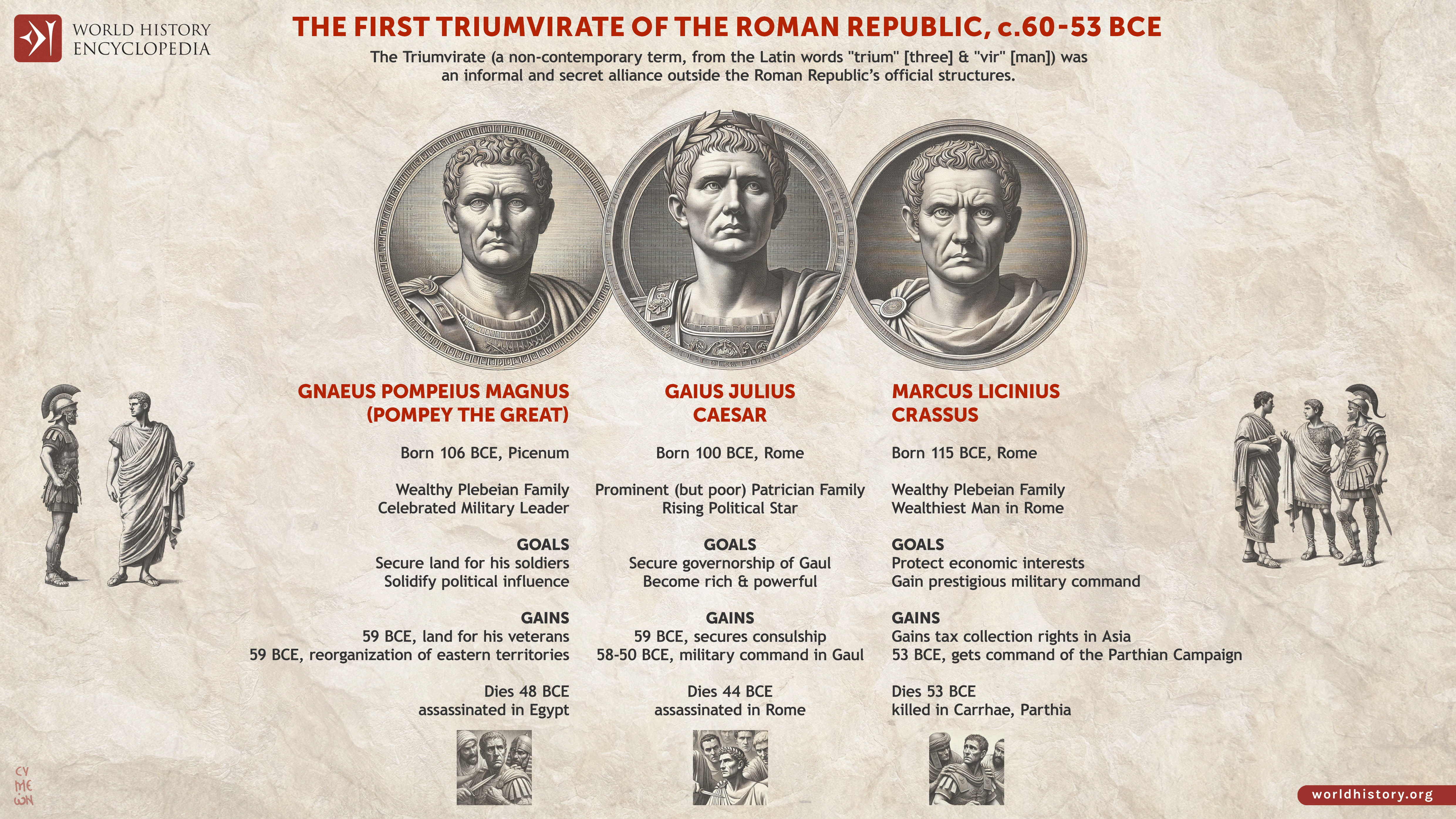
The First Triumvirate of the Roman Republic, c. 60-53 BCE
The First Triumvirate was an informal and secret political alliance formed in 60 BCE between three of Rome's most powerful figures: Julius Caesar, Pompey the Great, and Marcus Licinius Crassus. This alliance allowed them to bypass the Roman Senate's authority and consolidate power to achieve their individual goals. JuliusCaesar sought military command and political support to further his ambitions, Pompey wanted land for his veterans and the formal recognition of his eastern conquests, and Crassus, already the wealthiest man in Rome, aimed to enhance his wealth and gain the military fame he lacked, particularly through a campaign in the East. Crassus's desire for military glory, equal to that of Caesar and Pompey, ultimately led to his ill-fated Parthian campaign, where he met his death at the Battle of Carrhae, 53 BCE. The death of Crassus destabilized the alliance, leading to the eventual conflict between Caesar and Pompey, which contributed to the fall of the Roman Republic.
Uploaded by Simeon Netchev, published on 06 September 2024. The copyright holder has published this content under the following license: Creative Commons Attribution-NonCommercial-NoDerivs. This licence only allows others to download this content and share it with others as long as the author is credited, but they can't change the content in any way or use it commercially. When republishing on the web a hyperlink back to the original content source URL must be included. Please note that content linked from this page may have different licensing terms.