Dragons appear in the myths and legends of civilizations around the world from ancient times to the present day. Like the lion in ancient Mesopotamia, the dragon in some cultures (notably China) came to be associated with royalty and good fortune in that the king had subdued the forces of chaos that threatened order and stability.
In ancient Mesopotamia, the dragon was closely associated with the goddess Tiamat and chaos, defeated by the hero-godMarduk, but the image also appears as a symbol of protection and civilization, as with the mushussu dragon of the Ishtar Gate of Babylon. The same is true of China, Korea, and Japan where the dragon is both a threat and a defender, or order and bringer of rain. The image of the hero defeating the dragon is repeated in many different cultures – some having no contact with the others – and is thought to represent the triumph of order and civilization over the perceived disorder and capriciousness of the natural world.
Even so, once order has been established, dark forces still threaten to destroy it and return the people to an uncivilized state – and so the dragon continues to be depicted in art as both a defender of and a menace to civilization and, in Christian art, the works of God.
The following gallery presents images of dragons around the world from Mesopotamia to China to medieval Europe, including an image of the dragon-woman Melusine (sometimes depicted as a mermaid), best known today as the logo for Starbucks Coffee Company.

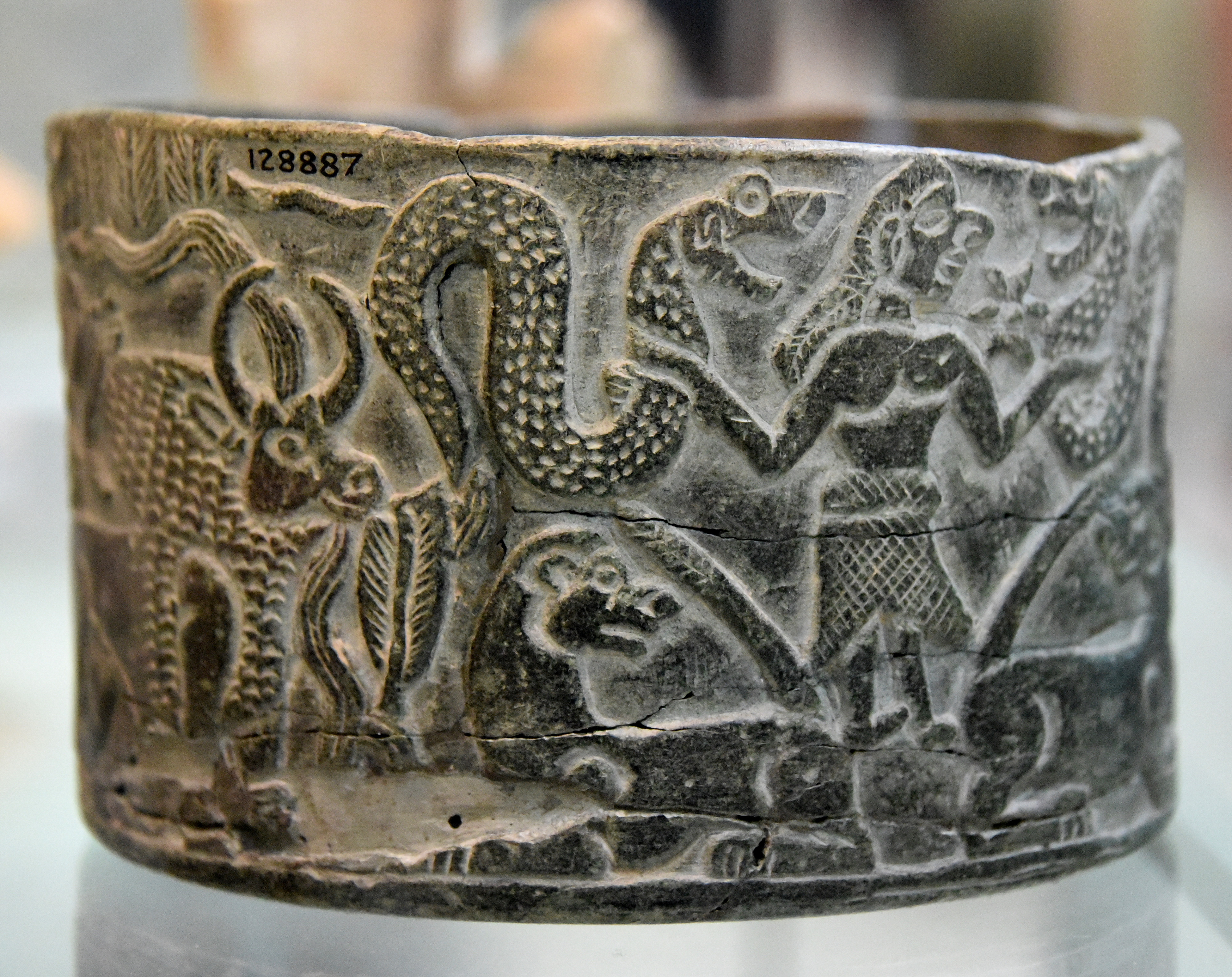
Circular chlorite box decorated with a mythological scene, made in modern-day Iran, but said to be from Khafajeh (Tutub), modern-day Iraq. Early Dynastic Period, 2600-2400 BCE.
The scene depicts a standing female with long plaited hair. She wears a kilt incised with a crosshatching pattern. With her hands, she holds a pair of antithetical spotted snakes; the snakes have a dragon head and a gaping mouth. One of a pair of antithetical humped bulls appears on the left side. The other female figure (her left hand appears on the extreme left) holds the tails of these snakes with her hands.
Dragon images first appear in the art of the Near East (Mesopotamia) and East Asia over 4000 years ago.
What do dragons symbolize?
The dragon is a symbol of untamed nature/chaos and also a protective agent defending civilization and the works of God (or the gods) from those very forces.
Do dragons appear in the Bible?
Yes, dragons are featured in the biblical books of Daniel and Revelation and, according to some scholars, in Job where Leviathan is identified as a dragon.
Who is the best-known dragon from mythology?
Fafnir from Germanic folklore and the Völsung Cycle is the best-known dragon from mythology along with the creature whose creation he influenced, Smaug, from The Hobbit by J. R. R. Tolkien.
Uploaded by Osama Shukir Muhammed Amin, published on 20 February 2018. The copyright holder has published this content under the following license: Copyright. You cannot use, copy, distribute, or modify this item without explicit permission from the author. Please note that content linked from this page may have different licensing terms.