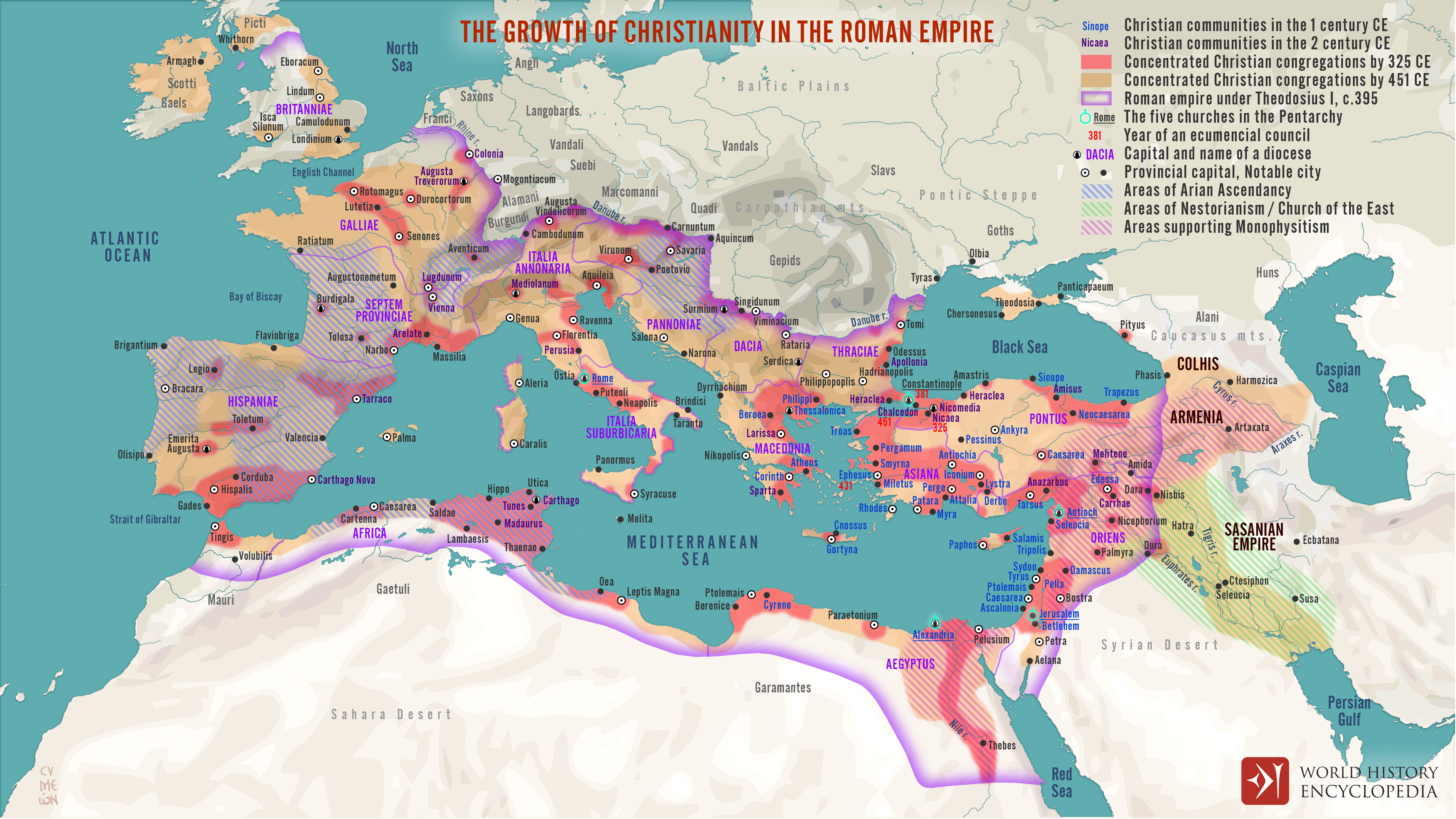
Map of the Growth of Christianity in the Roman Empire

The growth of Christianity in the Roman Empire from the 1st to the 5th centuries transformed a small religious movement rooted in Roman Judaea into one of the most influential institutions of the late ancient world. Emerging from a Jewish religious context, early Christianity spread primarily through interconnected cities and communities of the eastern Mediterranean before expanding across North Africa, Italy, western Europe, and beyond the imperial frontiers. Roman roads, maritime trade, shared languages, migration, and diaspora networks facilitated communication among Christian communities, while missionaries and local congregations helped establish new centers of worship. Growth was uneven and accompanied by periods of tolerance, local hostility, and occasional imperial persecution, culminating in the Great Persecution begun under Diocletian in 303.
The relationship between Christianity and imperial power changed decisively during the 4th century. Constantine I and Licinius granted Christians religious toleration in 313, while Constantine's patronage and the Council of Nicaea in 325 greatly strengthened Christianity's institutional position. Under Theodosius I, Nicene Christianity became the imperial standard of orthodoxy through the Edict of Thessalonica in 380 and the Council of Constantinople in 381. Yet efforts to establish doctrinal unity generated continuing debates over the Trinity and the relationship between Christ's divine and human nature. The councils of Ephesus in 431 and Chalcedon in 451 attempted to resolve these disputes but also contributed to enduring divisions among Chalcedonian, East Syriac, and Miaphysite Christian traditions. The expansion of Christianity therefore involved both continuity and change: the spread of religious communities, increasing imperial patronage, institutional consolidation, and persistent disagreement over belief and authority.