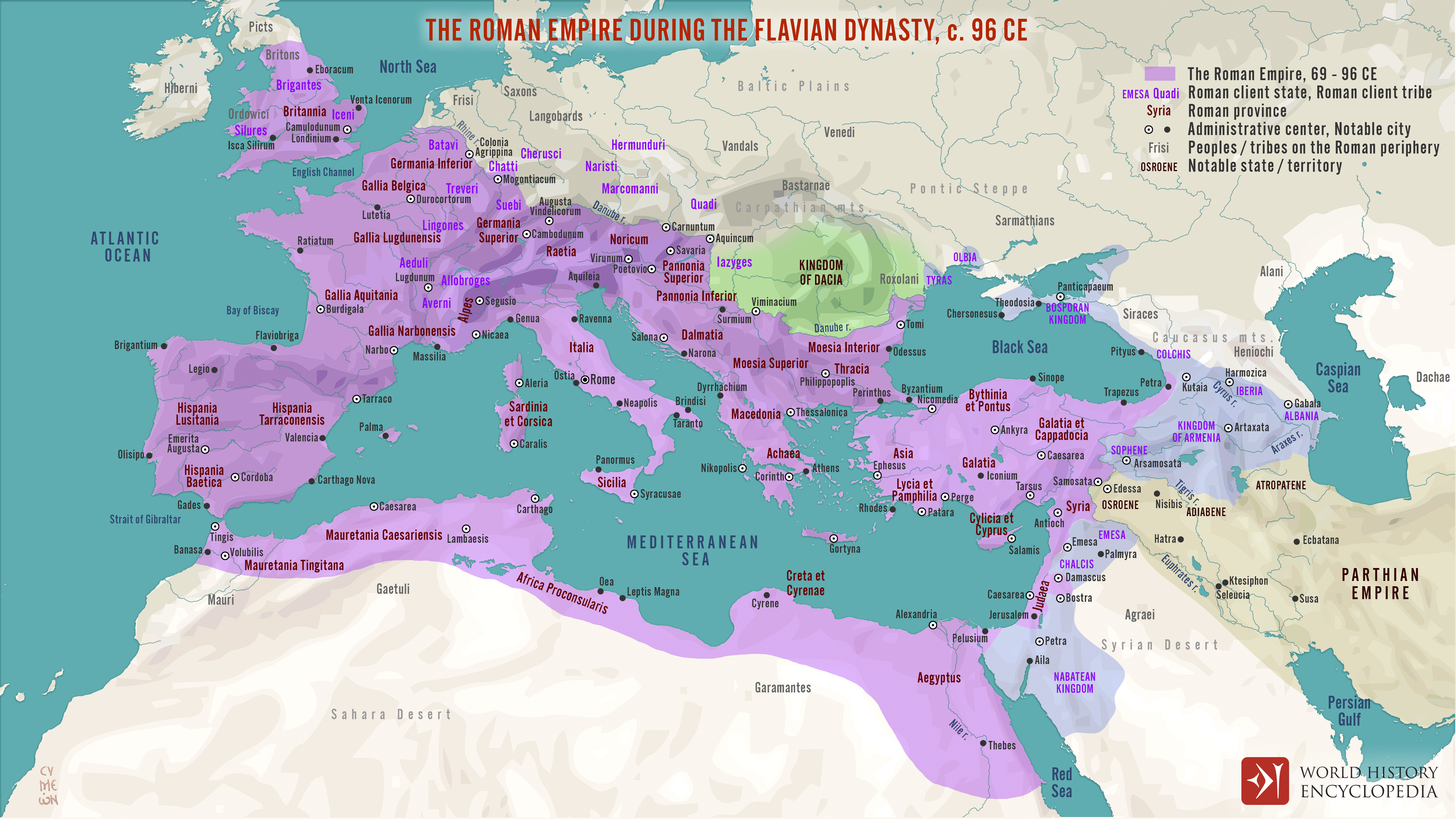
Map of the Roman Empire under the Flavians (69–96 CE)

The territorial organization of the Roman Empire at the close of the Flavian dynasty (69–96 CE) reflects a period of consolidation following the political crisis that ended the Julio-Claudian line. After the turmoil of the Year of the Four Emperors, Vespasian (reign 69–79 CE) established a new imperial house drawn from the Italian municipal elite rather than Rome’s traditional senatorial aristocracy. The Flavian rulers, Vespasian, Titus (reign 79–81 CE), and Domitian (reign 81–96 CE), strengthened imperial administration, expanded the role of the equestrian order in governance, and reinforced provincial control across a vast Mediterranean and European domain.
During this period the empire stretched from Britain and the Rhine–Danube frontier to North Africa and the eastern provinces of Syria and Judea. Military campaigns early in the dynasty suppressed the First Jewish–Roman War, culminating in the destruction of the Second Temple at Jerusalem in 70 CE under Titus. Domitian later consolidated frontier defenses along the Rhine and Danube and concluded an uneasy settlement with the Dacian Kingdom, a conflict that would resume under Trajan (reign 98–117 CE). Monumental building projects, including the Colosseum, symbolized renewed imperial confidence.