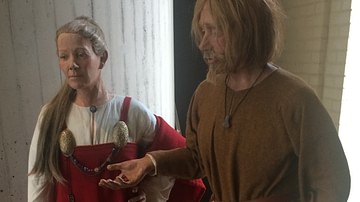
From 985 until sometime in the 1400s, Greenland was the farthest, most isolated outpost of medieval Scandinavian society. For nearly 500 years, the Norse Greenlanders built churches, kept livestock, and wore the same clothes as their contemporaries in faraway Europe. Then, for reasons that are still debated today, they vanished. The disappearance of the Norse Greenlanders – apparently without anyone noticing – remains one of history's most tantalizing mysteries.

The Flowering of Medieval Greenland
Scandinavian explorers led by Erik the Red settled Greenland in the late 10th century, and their descendants flourished there for hundreds of years as farmers and hunters. The largest community of Viking Age Greenland, known as the Eastern Settlement, was in the extreme southwest and consisted of about 500 farms. At its peak, it even boasted its own bishop and cathedral. Hundreds of kilometers north was the smaller, more marginal Western Settlement, near present-day Nuuk. The Western Settlement consisted of about 90 scattered farmsteads but was closer to Disko Bay, where the Norse obtained walrus ivory, medieval Greenland's most prized export.
Almost immediately, Greenland became a base for wider exploration. Norse sagas tell of lands discovered beyond Greenland, such as Helluland, Markland, and Vinland (now thought to correspond to Baffin Island, Labrador, and areas near the Gulf of St. Lawrence, respectively). The Norse did not permanently settle in any of these new lands, but they continued to visit Markland (Labrador) until at least 1347, probably to collect timber. The Scandinavian world had never been wider.

The Norse, however, were not the only people living in Greenland during their 500 years there. Early on, they found the remnants of an Arctic people known as the Dorset culture, who may have moved north before the Europeans arrived. In their later centuries in Greenland, the Norse came into contact with the Thule culture – the ancestors of modern Inuit.
The Mystery of the Western Settlement
While the Norse and Inuit sometimes coexisted peacefully, there are signs of trouble. In the mid-1300s, a Norwegian church administrator named Ivar Bardarson was living in Greenland, and he heard that the Inuit had overrun the Western Settlement. Ivar led a group from the Eastern Settlement to drive them away, but when he got to the Western Settlement, he found something shocking: no Norse and no Inuit, only livestock running free. Disturbed by what he found – or rather, what he did not find – Ivar and his companions fled back to the Eastern Settlement.
Ivar's enigmatic report was influential among historians for centuries, who took it at face value that the Inuit had wiped out the Western Settlement. However, the account is only preserved in later versions that may not accurately represent Ivar's findings, and not all of its details make sense. Ivar only mentioned visiting a single site – the wealthy Sandnes farmstead – with no indication that he visited any of the other farms. Even more perplexing is the presence of livestock still doing fine, even the cows, which have never fared particularly well in Greenland.
Modern archaeologists and historians have scrutinized Ivar's account. Ivar was in Greenland from the 1340s to 1360s, but some Western Settlement sites show signs of occupation until nearly 1400. Historian Kirtsen Seaver has proposed that the Western Settlement Norse actually went into hiding when they heard Ivar was on his way. After all, Ivar was a powerful, foreign church official whose purpose was to assess Greenland's churches and their ability to tithe. In other words, rather than being wiped out, the Western Settlement's wealthiest residents may have been hiding from the tax man.
Another possibility is that some Western Settlement sites were abandoned by the time Ivar got there, but others survived for another generation or two. Why Ivar seemingly failed to visit any of them is a mystery. Either way, by the late 1300s, the Western Settlement was no more.
The Final Stages of Norse Greenland
After Ivar Bardarson's time, there were signs of trouble in the surviving Eastern Settlement. In 1378, Greenland's bishop, Alf, died. The Greenlanders often waited years for new bishops to arrive from Norway, but they had no way of knowing Alf was their last one. From 1378 on, none of the bishops of Norse Greenland's see, Gardar, actually traveled to Greenland. A visitor from Iceland in the mid-1380s found that Gardar was headed by an old priest in the absence of a bishop. More trouble came in 1379, when The Icelandic Annals report that the Inuit killed 18 Norse Greenlanders – a significant figure considering that Norse Greenland had only a few thousand people at its peak.

By 1400, Greenland had lost its bishop and one of its two main settlements. Despite these hardships, the Eastern Settlement carried on for at least another couple of decades after the Western Settlement was deserted. Our last written record of the Eastern Settlement involves a ship of Icelanders who visited between 1406 and 1410. They reported that in 1407, a Greenlander named Kolgrim was burned at the stake for using witchcraft to seduce a married woman. In 1408, they reported happier, more mundane news: two of the Icelanders got married at beautiful Hvalsey Church, the ruins of which are still plainly visible today. The Icelanders arrived back home in 1410. That is the last news we have of Norse Greenland.
If the Eastern Settlement was in serious decline by 1410, the Icelanders did not say anything about it. Their final story implied everything was normal: the marriage had been celebrated according to all the proper customs and was officiated by priests. Even the burning of Kolgrim does not reveal anything unique about Norse Greenland. Witch burning occurred in late medieval and early modern societies that decidedly did not collapse.
When Did Norse Greenland End?
So if Norse Greenlanders were still alive and well in 1410, when did they disappear? Historians' estimates have changed with time. In the early 20th century, archaeologist Poul Nørlund reasoned they were alive as late as 1480, based on the discovery of a “Burgundian cap” that resembled styles popular in 15th-century Europe. Due to this finding, 20th-century historians often reasoned that Norse Greenland persisted into the late 1400s and that they clearly still had some contact with the outside world. In 1971, Finn Gad could confidently say that parts of the Eastern Settlement were occupied after 1480. In the 1990s, Kirsten Seaver speculated that some Norse Greenlanders could have been alive in 1500.
However, when the Burgundian cap was radiocarbon dated, it came back over 100 years too early for this to be the case. A date near 1500 began to appear increasingly unlikely, and some recent historians have taken a hard turn in the opposite direction. Arnved Nedkvitne has argued that the Norse died out almost immediately after the Icelanders left in 1410, as there is no hard proof that they existed beyond this point.
That said, some of the clothes from the Eastern Settlement have fairly late dates, including one dress radiocarbon dated to 1430, plus or minus 15 years, that was buried with a Norse woman. When the woman in the dress died, there were obviously still people left to bury her. When did those people die? Today, most historians place the termination of Norse Greenland around roughly 1450.
Many Causes, but No Smoking Gun
The proposed causes of Norse Greenland's decline have also changed dramatically over time. In the colonial era, Ivar Bardarson's tale of an Inuit overrun was taken literally. In the late 20th century, climate change became a leading theory, as evidence began to mount that the North Atlantic region became stormier, less predictable, and colder in the later Middle Ages. When Erik the Red had settled Greenland in the late 10th century, it was just as warm as it is today, if not a bit warmer, but within a few hundred years, it had grown drastically colder. This trend is sometimes referred to as the 'Little Ice Age,' and several books and documentaries have noted Norse Greenland's disappearance as the climate turned nastier. Perhaps for a farming and hunting society that had always existed on the margins, prolonged cold spells and unpredictable seasons were simply too much to overcome.

Theories of environmental destruction went hand in hand with the focus on climate change, advanced in the academic world by historians such as Thomas McGovern and popularized for a wide audience in Jared Diamond's controversial bestseller, Collapse. Diamond was particularly harsh toward the Norse for their alleged failure to adapt to the worsening climate, pointing to their preference for trendy European fashions instead of pragmatic Inuit clothing. Diamond also blamed the Norse for failing to adopt Inuit hunting methods and for harming their arctic environment through overgrazing.
However, experts (even McGovern) have pushed back against Diamond's accusation that the Norse failed to adapt. Early on, the Norse obtained just 20% of their food from the sea and 80% from the land, but by the end of the colonies, the ratio had reversed, as even Diamond acknowledges. Likewise, the Norse were careful not to overhunt seals and gave pastures time to recover. Their famous but risky walrus hunts were also an example of making full use of their new environment, as walrus ivory was a valuable trade commodity. Norse Greenlanders were also still making their voyages to Markland (Labrador in present-day Canada) to collect wood as late as 1347, when a boat from Markland blew off course and landed in Iceland. Rather than failing to adapt, the Norse seem to have gone to extreme efforts to obtain resources while also drastically changing their diet.
Norse Greenland may have also become more isolated from Europe toward the end of the medieval period. Medieval Greenland had been peripheral even in the best of times, but Norway made it illegal to trade in Greenland without royal permission. An official Greenland knorr (ship) provided regular contact between Norway and Greenland for a time, but it sank in 1369. From then on, all sailings to Greenland were 'accidental,' although historians think this is just the excuse sailors used when returning from illicit trade in Greenland. Still, from 1369 on, there were only four known sailings to Norse Greenland. Even though there were likely more visits than we have record of, Greenland's economy took a hit when elephant ivory entered the market, making walrus ivory less valuable.
When Bishop Alf died in 1378 and no one arrived to replace him, Greenland lost one more connection to the European world. Even the church could not reach Greenland after this point, although there were still remnants of the old priesthood noted in 1385 and 1408. What happened when the last validly ordained priest died? Papal documents from 1448 and 1493 mention pirate attacks and decaying Christianity in Greenland, although the 1493 letter concedes that no one had gone there in 80 years, so it is unclear how they came to this conclusion. For what it is worth, Greenlanders were buried with crosses right up until the end, but it was just one more way the colonies had become a forgotten and neglected part of the medieval world.
Perhaps by the early 1400s, when the climate near Greenland was at its worst, sailing there was simply too dangerous. As early as the mid-1200s, a source known as The King's Mirror warned that due to sea ice, Greenland should be approached from the south and southwest, which differed from the traditional direct route. A hundred years later, Ivar Bardarson similarly advised that sailing to Greenland via the old routes had become extremely dangerous due to encroaching sea ice. If the climate had deteriorated that much by the mid-1200s and 1300s, how much worse had it grown by 1400?

With all these causes in mind, how did the end play out in practice? This is where evidence gives way to conjecture and speculation. No one really knows what the death blow was or if there even was one. Perhaps the Norse slowly immigrated to Europe, a slow trickle of tattered refugees who went unnoticed by chroniclers. Maybe the last Norse Greenlanders died at sea trying to escape, leaving no trace whatsoever. Maybe Ivar Bardarson and Inuit legends are correct that warfare between the Norse and the Inuit weakened the colonies. Maybe there is some truth to the rumors of pirate attacks. Or maybe the end came slowly and painfully, with the Norse starving to death one by one. No one can say for sure.
A Success Story?
Today, historians avoid ascribing Norse Greenland's disappearance to a single cause. 'All of the above' is an increasingly appealing answer. It is reasonable to say that Norse Greenland's demise was due to some combination of climate change, increasing isolation, and economic factors. The Norse did, however, adapt as best they could to these hardships. Perhaps the biggest surprise about Norse Greenland is not that it vanished, but that it managed to survive in such a harsh environment for nearly 500 years in the face of overwhelming difficulties.