



The Pacific War concerned the theatre of the Second World War (1939-45) fought in the Pacific Ocean and eastern parts of Asia between Japan and the United States and its allies. Japan had expanded its empire in the region throughout the 1930s, but the sneak attack on the US base at Pearl Harbor brought that country into the war. The military and industrial might of the US permitted it to launch offensive after offensive and, despite heavy casualties, push the Japanese military back to the home islands, which were then bombed relentlessly. The Pacific War and WWII ended following the dropping of two atomic bombs and Japan's surrender in August 1945.
Causes: Japan's Expanding Empire
In search of prestige, territory, new markets, and vital resources like oil, the Japanese military had been steadily expanding the Japanese Empire through the 1930s. Japan was led by a military government where Emperor Hirohito had only a nominal influence. Culturally, many Japanese had been educated from a young age to believe they were superior to everybody else because of their race and to hold an unswerving loyalty to the emperor. In short, the military government could persuade the population that warfare was a natural form of foreign policy and that Japanese domination of the Pacific was inevitable.
Up to late 1941, it seemed the confidence of the military government was justified. Japan occupied Manchuria, Formosa (Taiwan), Korea, parts of coastal China, and French Indo-China (which included what is today Laos, Cambodia, and parts of Thailand). Japan also controlled the Mariana, Caroline, and Marshall Islands, and had done so since the end of the First World War (1914-18). Japan was not alone in its imperialism. Britain, France, the Netherlands, and the United States all had their own colonial possessions in the Pacific region.
On 7 December 1941, Japan infamously launched its attack on Pearl Harbor in Hawaii, home of the US Pacific Fleet. It was hoped that a preemptive strike on the US Navy would allow Japan to dominate this theatre of WWII. The Japanese military commanders had perhaps grown over-confident following their string of victories in Asia and the Pacific.

The US was not militarily involved in WWII, but it was giving aid to the enemies of the Axis powers (Germany, Italy, and Japan). Defeats to Nazi Germany by the Netherlands, France, and Britain in Europe in 1940 meant they were less likely to be able to defend their territories in the Pacific. In addition, a peace treaty with the USSR, signed in April 1941, meant Japan was free to concentrate on expansion in the Pacific. Finally, the land-based war between Japan and China had become rather bogged down. It seemed to many Japanese militarists, especially the Imperial Japanese Navy, that this entire region, half of the globe, was an easy target for domination.
There were additional reasons for attacking a US naval base. The most important was that the US embargo on the sale of oil and other raw materials to Japan, imposed in 1941, meant the state was obliged to seek the resources it needed through conquest. Japan could only produce 6% of its oil requirements, while other necessary materials included iron ore, coal, lead, tin, rubber, and nickel. South-East Asia was particularly rich in oil fields. By knocking the US Navy out of the war in one blow, the Japanese Navy could concentrate on occupying these oil fields. It was even hoped that the US government, with many Americans preferring a policy of isolationism, might prefer to negotiate a peace with Japan if it had not enough warships to conduct a fight back.
The Pearl Harbor Gamble
The attack on Pearl Harbor required absolute surprise, and so the Japanese government did not declare war on the US until a few hours before (as it happened, diplomatic delays meant the declaration came after the first bombs were dropped). The attacks did achieve surprise, despite military intelligence suspecting it beforehand. Most US commanders thought the Philippines would be the first place to be attacked if Japan ever did so.

The Japanese task force ultimately sank or seriously damaged 18 ships (including eight battleships), destroyed or damaged nearly 200 US aircraft, and killed 2,403 people and wounded 1,178 (Dear, 680). The Japanese force lost just 29 aircraft and six submarines. Crucially, the US aircraft carriers were not in Hawaii at the time, and vital supply dumps were left intact. As a consequence, after the US entered the war in response to the raid, the US Navy was able to recover. The attack was a tactical victory but not a strategic one. It was not the end of the Pacific War, but only the beginning.
That same December, Japan successfully launched attacks on British-controlled Malaya, Burma (Myanmar), and Hong Kong. With the US Navy temporarily crippled and the British distracted by events in other theatres, the Japanese Empire expanded dramatically. Singapore was captured in February 1942. Through March and April, Japanese forces ripped through the main islands of the Dutch East Indies (Sumatra, Java, Borneo, Celebes, and New Guinea). It looked like Japan would soon control the entire western Pacific from northern China to Australia. All that remained to grab was Papua and the Solomon Islands. Australia would then be fearfully exposed to Japanese air attacks. If Japan could then take Fiji, Samoa, and New Caledonia, further east in the Pacific, the US Navy would be completely cut off from its supply chain that began in Brisbane and Sydney.
The US Fightback
The first direct reply the US services gave to Japanese aggression was the Doolittle Raid of 18 April 1942. The raid, named after its leader, Lt-Colonel James H. Doolittle, saw 16 US B-25 bombers attempt to hit Tokyo and other targets in Japan after taking off from the aircraft carrier Hornet, located 700 miles (1,100 km) from the Japanese capital. Without sufficient fuel to return to the Hornet, the B-25 bombers, after hitting Tokyo, had to land in allied China. The strategic value of the raid was very limited, but it demonstrated both to Japan and the US public that the US armed forces were capable of striking at the very heart of the enemy. Just like the attack on Pearl Harbor, shock value far outweighed material damage (100 buildings damaged and 50 people killed).

The fightback at sea began with the Battle of the Coral Sea in May 1942. This was the first aircraft carrier battle in history. The US prevented Japan from occupying Papua and the Solomon Islands. The commander of the US Pacific Fleet, Admiral Chester W. Nimitz (1885-1966), was aided by military intelligence cracking the coded messages of the Japanese Navy. In the battle, Japan lost the light carrier Shōhō – the first time it had lost a carrier in the war – while the US lost the carrier Lexington. It was a price worth paying to finally end Japanese expansion in the Pacific and inflict on the Japanese Navy its first operational failure of WWII. Even more significantly, two Japanese carriers were so badly damaged they could not participate in the next, much more crucial naval encounter.
The Battle of Midway in June 1942 is widely considered the turning point of the war, since after it, the Japanese Navy largely fought a defensive war of steady retreat. At Midway, the US Pacific fleet sank four Japanese aircraft carriers for the loss of only one US carrier, the Yorktown, and destroyed nearly 250 Japanese aircraft. The heavy losses in experienced pilots and maintenance crews were another serious setback. The Japanese people were not informed that four carriers had been lost at Midway in just 24 hours.
Admiral Yamamoto Isoroku (1884-1943), Commander-in-Chief of the Combined Fleet, had made several important mistakes, ones which, unfortunately for Japan, would be repeated again and again in the Pacific War. Historian M. M. Boatner notes that Yamamoto:
…failed to follow the Napoleonic dictum of mustering all available force for the main effort; he did not position himself to control the action… he failed to brief major subordinate commanders fully on the plan; he was careless about deploying reconnaissance and screening forces; but perhaps his greatest fault was overconfidence.
(622)

The economic, industrial, and military might of the US was clearly demonstrated with the construction of 14 Essex-class carriers in 1943. With these carriers came thousands of aircraft. The US was ready to go on the offensive.
Taking the Pacific Islands
Removing Japan from the territory it had occupied in the Pacific was far from easy. Most of the fighting would have to be done on small islands, pushing the Japanese military further northwards with a series of amphibious landings. The first such landing came in the Solomon Islands. The Guadalcanal Campaign lasted from August 1942 until February 1943 and was a series of 50 land, air, and sea battles.
19,000 US Marines were landed in Guadalcanal, the main island of the archipelago. In all, 82 ships were involved in the operation, which achieved its objective of surprise. The Japanese Navy responded to the attack by sending a strike force from their base at Rabaul, Papua, which disrupted the US screening force and the landing itself. The Japanese army then landed its own force. Both sides wanted to control the island's vital airstrip. The fighting in the jungle interior was bitter, with many Japanese soldiers fighting to the death or even pretending to surrender and then blowing up themselves and their captors using grenades. This was to be an ominous feature of the Pacific War from now on. More naval battles and more troops landing eventually swung this battle of attrition in the US's favour. The US suffered 6,111 casualties. Japan suffered around 24,000 men killed. Japan could no longer threaten the vital US supply lines stretching back to Australia.

The next battles came in the Gilbert and Marshall Islands Campaign (November 1943 to February 1944). The US strategy was now clear. Often called 'island-hopping,' US forces would attack and capture one island group, and then use that group as an air and naval base to attack another archipelago. Defeating the Japanese military was a challenge, despite the US forces perfecting the art of amphibious assaults: heavy naval and air bombardment followed by armoured LVTs (Landing Vehicles, Tracked) depositing thousands of troops on the beaches, and then providing yet more overwhelming air support as the troops moved inland with tanks.
The Battle of Tarawa Atoll in November 1943 became one of the epic struggles of the Pacific War. As became typical, Japanese troops secreted themselves in a bewildering network of concealed defences and held them to the last man. The US Marines learnt quickly how best to fight this unseen enemy using bulldozers, explosives, and flamethrowers. Even when victory seemed to have been achieved, the Japanese soldiers, believing surrender dishonourable and that they would be tortured if captured, launched a final desperate banzai charge to take as many US soldiers out as possible. The banzai attack was so called for the battle cry the soldiers made as they suicidally charged: Tenno heika banzai ('Long Live the Emperor'). US control of the Gilbert and Marshall Islands enclosed Japan within the western half of the Pacific. US forces could now launch attacks on Japan's main naval base at Truk Atoll (modern name: Chuuk Lagoon) in the Caroline Islands and begin to push deeper into the Japanese Empire.
Bombing Campaign & Philippines
At the same time, the Allied bombing campaign of Japan continued, resulting in over 60 cities suffering tremendous destruction. The aim was to destroy industrial sites vital for Japan's war effort, but the incendiary bombing was indiscriminate, and tens of thousands of civilians lost their lives. There was, too, fierce fighting still going on against Japanese forces in parts of Southeast Asia, notably in Burma (Myanmar) and in mainland China.

Another major area of fighting was in the Philippines Campaign. Here, in US-controlled territory, General Douglas MacArthur (1880-1964) commanded the US Far East forces from his headquarters in Manila. Japan attacked the US airbase at Luzon at the same time as the raid on Pearl Harbor. A Japanese invasion in December 1942 caused a US withdrawal. Filipino guerrillas kept up a resistance fight until US forces returned under MacArthur in the form of a carrier group in September 1944 and then a full invasion force in October. Here, as elsewhere, the Japanese defence was determined and prolonged.
The Road To Victory
Meanwhile, back in the Pacific, the pattern of massive US amphibious assaults and dogged Japanese resistance continued. Amongst the more important and bloody battles were the Battle of Saipan (June-July 1944) and the Battle of Guam (July-August 1944), which gained the US control of the Marianas. The US offensives were consistently achieving an efficient and fully coordinated use of its combined services of the navy, naval air force, marines, army infantry, army air force, and military intelligence. The US Air Force could now operate airfields with Boeing B-29 Superfortress bombers that could hit Japan directly. The bombing of Tokyo in WWII became a terrible example of the destruction the US could inflict upon its enemies.
Nimitz set up his headquarters on Guam, and from there, he would direct the rest of the Pacific campaign. Another crushing Japanese defeat came at the Battle of the Philippine Sea (19-20 June), where, in the war's largest carrier battle, around 400 Japanese aircraft, 17 submarines, and three aircraft carriers were lost. After these losses, the Japanese prime minister, General Hideki Tojo (1884-1948), no longer supported by the emperor, was ousted from power on 18 July. Tojo was replaced by Kuniaki Koiso (1880-1950), but the war went on.

Two more amphibious landings and two more gruelling victories for the US came in the Battle of Iwo Jima and the Battle of Okinawa in the spring of 1945. The historian D. Marston noted that Iwo Jima was "the bloodiest battle in Marine Corps history and the only landing in which the Japanese inflicted more casualties on their enemy than they suffered themselves" (172). Nimitz stated: "Among the Americans who fought on Iwo Jima, uncommon valor was a common virtue" (Wright, 10). 27 Medals of Honour were awarded for valour displayed in the battle.
Okinawa was historically considered part of the Japanese home islands. It was eventually taken, but with a tremendously high 35% casualty rate amongst the Allied troops. With around 100,000 Japanese combatants and up to 150,000 civilians killed, this was the last major battle of WWII.
The Japanese military was now increasingly desperate. Already, a significant number of kamikaze suicide missions had been flown against targets at Okinawa. Aircraft were being carefully husbanded to fly more kamikaze missions when US troops assaulted the main Japanese islands, as seemed the next inevitable phase of the war. Japan could still call on over 2.5 million troops to defend itself. In the event, an invasion never came. The US had been secretly developing a new weapon which promised to end the war in a single day.

The Atomic Bomb
A team of US and European scientists had been working since August 1942 on the secret Manhattan Project to develop an atomic bomb. The project involved over 100,000 individuals and cost around $2.5 billion. By July 1945, two nuclear bombs had been created and could be delivered by plane to their targets. Here was a way to avoid an amphibious operation on Japan's main islands, which the Pentagon estimated, even if successful, would result in at least half a million US dead or wounded.
The Potsdam Conference (July-August 1945) saw US President Harry S. Truman, UK Prime Minister Winston Churchill, and then his successor, Clement Attlee, and Soviet Premier Joseph Stalin issue a surrender ultimatum to Japan, known as the Potsdam Declaration, on 27 July. The ultimatum was ignored. The Allied leaders all agreed the nuclear bombs should be dropped on Japan. It was decided not to give any warning to increase the psychological impact of the attack. The targets selected were to be relatively unaffected by the conventional bombing campaign for the same reason. The hope was that such a terrible new weapon would force Japan's military government to immediately surrender.
The uranium bomb 'Little Boy' was dropped by the B-29 Enola Gay on the Japanese city of Hiroshima on 6 August 1945. The plutonium bomb 'Fat Man' was dropped by the B-29 Bockscar on Nagasaki three days later on 9 August 1945. Estimates vary, but perhaps as many as 140,000 people were killed in the attack on Hiroshima. At Nagasaki, the bomb killed around 74,000 people and injured another 75,000. In both attacks, tens of thousands of survivors suffered the negative effects of radiation exposure in the following weeks, months, and years; indeed, many more people died in this way than in the initial blasts. Emperor Hirohito declared his willingness to sign the Japanese surrender on 15 August.
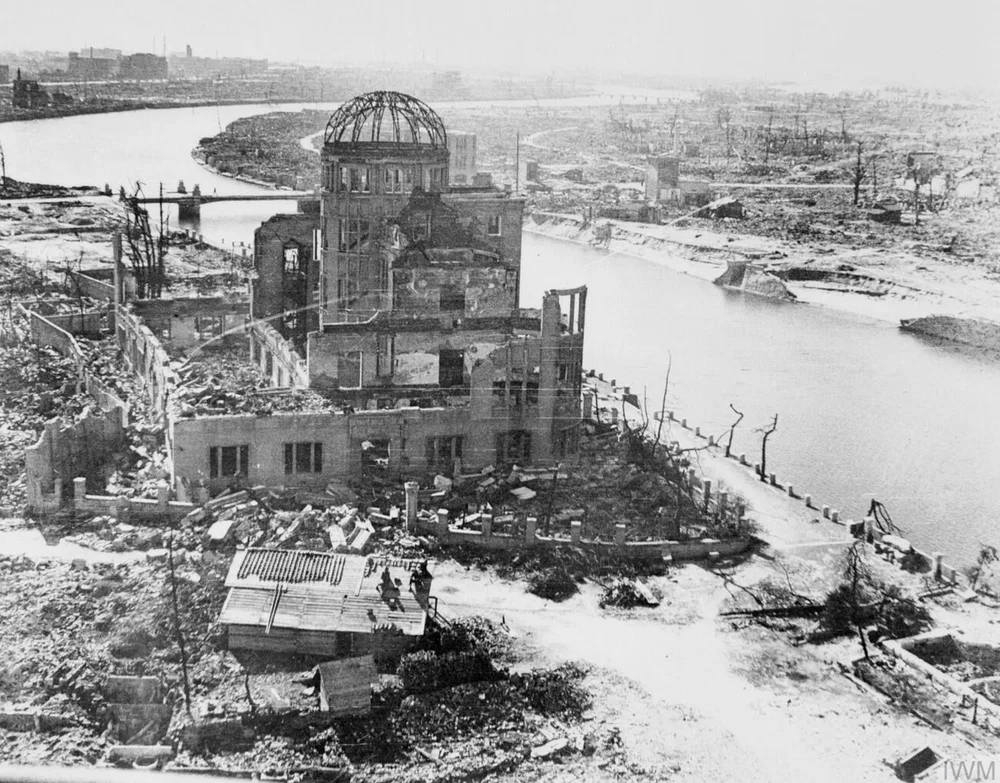
The two bombs demonstrated to the USSR that the USA now possessed the most powerful weapon on Earth. These two military giants had already been jostling for who would control which pieces of territory once occupied by the Axis powers. In fact, the dropping of the bombs and the effect on present and future US-Soviet relations had been a prime objective of the whole project all along, even if saving the lives of Allied servicemen had been the public justification. The US and its allies had won the Pacific War, and so WWII ended, but the nuclear age had begun and so, too, the long Cold War between the USA and the USSR and their respective allies.


