
Search Articles
Browse Content (p. 171)

Article
The Battle of Kadesh & the Poem of Pentaur
The Poem of Pentaur is the official Egyptian record (along with The Bulletin) of the military victory of Ramesses II (known as The Great, 1279-1213 BCE) over the Hittite King Muwatalli II (1295-1272 BCE) at...

Article
The Gifts of Isis: Women's Status in Ancient Egypt
An inscription on an Egyptian papyrus dating from the 2nd century CE relates that the goddess Isis, bestowing gifts on humanity at the beginning of time, gave as much power and honor to women as she...

Article
Phoenician Names
Phoenician names are generally composite words with a specific meaning. The naming of children had a significance in the Ancient Near East that is difficult to understand nowadays. By choosing a name for their child, the parents...
Article
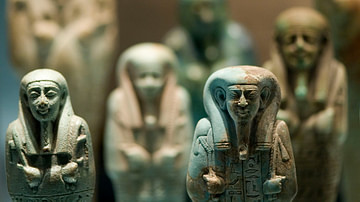
Shabti Dolls: The Workforce in the Afterlife
The Egyptians believed the afterlife was a mirror-image of life on earth. When a person died their individual journey did not end but was merely translated from the earthly plane to the eternal. The soul...

Article
Queen Hatshepsut: Daughter of Amun, Pharaoh of Egypt
Hatshepsut, whose name means "Foremost of Noble Women" or "First Among Noble Women" (royal name, Ma'at-ka-re, translated as "spirit of harmony and truth") was the fifth ruler of the 18th Dynasty (r...

Article
Diodorus Siculus on Fate and Philip of Macedon
Diodorus Siculus, the 1st century BCE historian, took great pride in precision of description but, even so, could not refrain from adding his own personal views and interpretations of historical events...

Article
The Greek Phalanx
One of the most effective and enduring military formations in ancient warfare was that of the Greek phalanx. The age of the phalanx may be traced back to Sumeria in the 25th century BCE, through Egypt, and finally appearing in...
Article
The Battle of Gaugamela, 331 BCE
After securing the eastern Mediterranean seaboard and Egypt, Alexander the Great pushed east into Mesopotamia with the intention of bringing Darius to battle. After crossing the Euphrates River unopposed, he marched...

Article
History of Assyria
The foundation of the Assyrian dynasty can be traced to Zulilu, who is said to have lived after Bel-kap-kapu (c. 1900 BCE), the ancestor of Shalmaneser I. The city-state of Ashur rose to prominence in northern Mesopotamia, founding...

Article
Tacitus on Boudicca's Revolt
Tacitus (full name, Publius Gaius Cornelius Tacitus, ca. 56 – ca. 117 CE) was a Roman Senator and an important historian of the Roman Empire. In the following passages Tacitus gives an account of the Iceni Queen Boudicca's...
