
Search Articles
Browse Content (p. 169)

Article
Protagoras of Abdera: Of All Things Man Is The Measure
Protagoras of Abdera (l.c. 485-415 BCE) is most famous for his claim that "Of all things the measure is Man, of the things that are, that they are, and of the things that are not, that they are not"...
Article
The Island Kingdom of Aegina: The Old Gods Still Whisper Their Truths
Today, traveling an hour by ferry from Piraeus, the port of Athens, the first remnant of Aegina's great past a visitor will see is the lonely pillar of Apollo rising from the trees on...

Article
The Eleusinian Mysteries: The Rites of Demeter
The Rites of Eleusis, or the Eleusinian Mysteries, were the secret rituals of the mystery school of Eleusis and were observed regularly from c. 1600 BCE - 392 CE. Exactly what this mystic ritual was no...

Article
The After-Life In Ancient Greece
In ancient Greece the continued existence of the dead depended on their constant remembrance by the living. It was understood that the soul lived on after bodily death in the realm known as Hades; but that land had...
Article
The Papyrus Lansing: Be A Scribe…Or Else!
The Papyrus Lansing is an ancient Egyptian document that dates to the reign of the Pharaoh Senusret III (also known as Sesostris III, and, arguably, the legendary Sesostris written of by Herodotus) the 5th...
Article
Hipponax & Misogyny in Ancient Greece
It has always been recognized that women in the ancient world were considered only a little higher in value than the man's cattle or plow and, sometimes, not even accorded that kind of respect. Examples of misogynistic...
Article
The Meroe Head
The Meroe Head, so-called because it was found beneath a temple in the ruins of Meroe, is the head of a larger-than life statue of Gaius Julius Caesar Augustus (better known as Augustus Caesar) the first Emperor of Rome (reigned...
Article
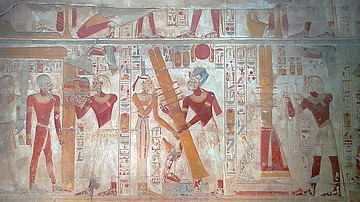
The Forty-Two Judges
The Forty-Two Judges were divine entities associated with the afterlife in ancient Egypt and, specifically, the judgment of the soul in the Hall of Truth. The soul would recite the Negative Confession in their presence as...

Article
Heraclitus' Fragments
Heraclitus of Ephesos (l. c. 500 BCE) was an early Pre-Socratic philospher who claimed that the First Cause of existence was fire and that life itself was characterized by strife and change. Heraclitus did not see this condition...
Article
The Tale of the Shipwrecked Sailor: An Egyptian Epic
The Tale of The Ship-Wrecked Sailor is a text dated to the Middle Kingdom of Egypt (2040-1782 BCE). It is a story of adventure whose purpose, besides entertainment, would have been to impress upon...
